
Track Going Data and Weather Impact on Greyhounds
Best Greyhound Betting Sites – Bet on Greyhounds in 2026
 Available in US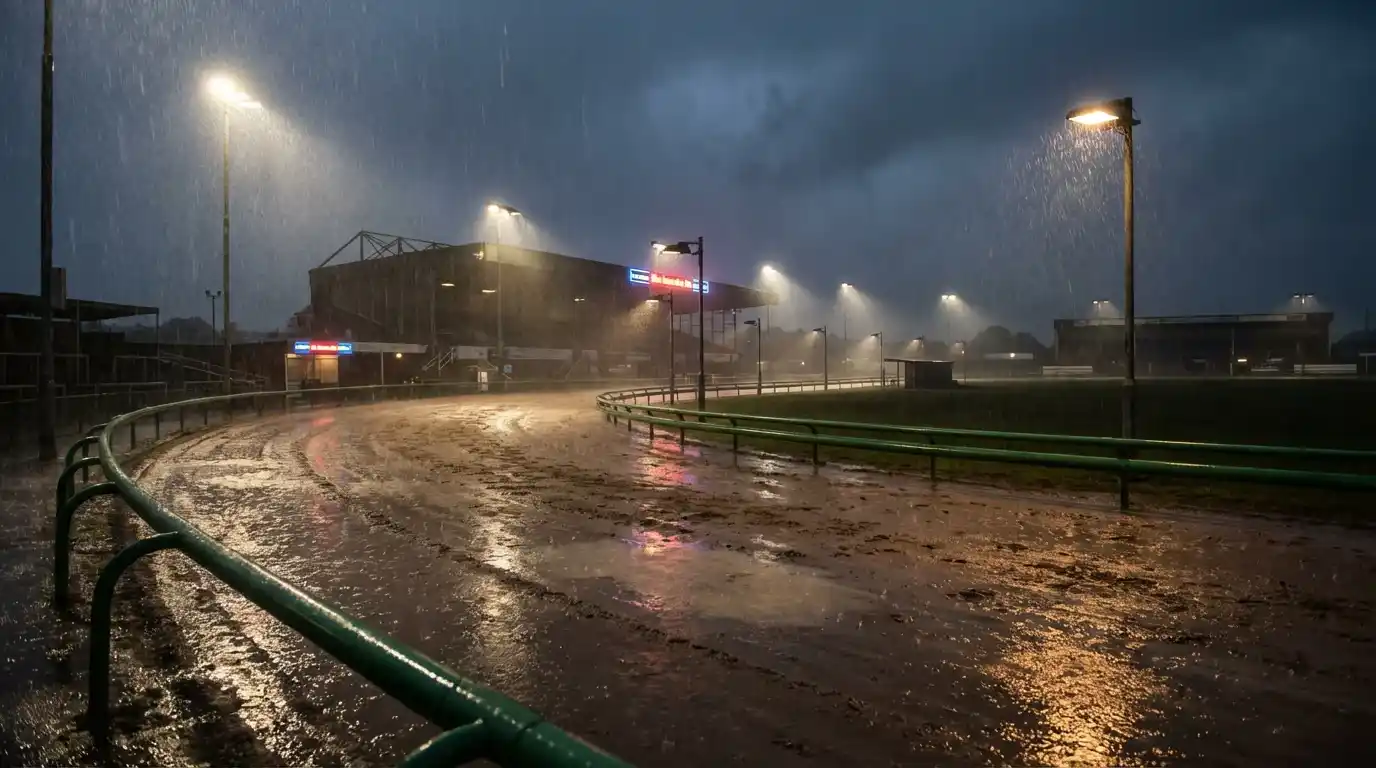
Weather Impact and Track Conditions on Greyhound Performance
Rain slows the sand, wind changes the bends, and cold sharpens the dogs. Weather is the variable that most greyhound punters acknowledge in theory and ignore in practice. The form book records what happened on the night. It rarely records the conditions under which it happened — and yet those conditions directly influence race times, running patterns, and which type of dog gains an advantage.
Rain is the most significant weather factor. UK greyhound tracks use sand-based surfaces, and when rain saturates the sand, the going changes. A wet track is slower than a dry one: the sand becomes heavier, the dogs work harder to maintain speed, and race times increase. Heavy rainfall can add several lengths’ worth of time to a standard-distance race compared to the same card run in dry conditions. This slowdown is not uniform across all runners — it affects different dogs differently based on their build, running style, and physical strength. Powerful, strongly built dogs tend to handle wet conditions better than lighter, speedier types, because the effort of driving through heavy sand rewards physical strength more than raw pace.
The effect of rain on the track surface also changes the dynamics at the bends. A wet surface offers less grip, which means dogs carrying momentum into a tight bend are more likely to drift wide. Inside runners that rely on a clean rail line through the bends may find the wet surface less accommodating, while wider-running dogs may be less disadvantaged than usual because the outside of the track is no slower than the inside when the entire surface is saturated. This is a subtle shift, but over a full meeting on a wet evening, it shows up in the results — trap bias patterns can change when the going changes.
Wind is underrated as a form factor. Greyhound tracks are open-air facilities, and a strong crosswind or headwind on a particular stretch of the track alters the effort required to maintain speed. A headwind down the home straight slows the finishing times and can turn a close finish into a more spread-out one, because dogs tire faster when running into resistance. A tailwind on the same straight has the opposite effect, flattering finishing speeds. The practical impact on betting is that wind-affected times should not be taken at face value when comparing form across different meetings. A dog that posted 29.50 seconds in a headwind may have produced the equivalent of 29.20 in calm conditions — a meaningful difference when comparing it with a rival whose 29.30 was recorded on a still evening.
Temperature affects the dogs themselves. Greyhounds are lean, muscular animals with minimal body fat, and they perform differently in cold and warm conditions. Cold weather tends to sharpen dogs — they warm up quickly during exercise and often produce quicker early splits in cooler temperatures. Hot weather can cause fatigue more quickly, particularly over longer distances, and dogs racing on warm summer evenings may show less finishing speed than the same animals racing in autumn or winter. UK summers are mild enough that heat is rarely a dominant factor, but the difference between a July evening and a November meeting is measurable in the times.
Track Going Descriptions and What They Mean for Punters
Going reports at greyhound tracks are less detailed than horse racing, but they still matter. In horse racing, the going is described on a standardised scale from firm through good to soft and heavy, and the going report is treated as a primary form factor. In greyhound racing, the going descriptions are simpler — typically fast, normal, slow, or wet — and they receive less attention from both bookmakers and punters. This relative neglect is an opportunity for anyone who pays attention to it.
A going description of “normal” indicates standard track conditions: the sand is dry or lightly damp, and race times are expected to fall within the typical range for that track and distance. This is the baseline against which all other conditions are measured. Most BAGS meetings are run on normal going, which means the form book’s accumulated times are predominantly recorded under these conditions. When you compare dogs’ times against each other, the assumption that conditions were similar is usually valid — provided you are comparing races run on normal going.
A “slow” going description indicates that the surface is heavier than normal, typically due to rain or poor drainage. Times on slow going will be measurably longer than on normal going — often by several hundredths of a second, which in greyhound racing translates to one or two lengths. A dog that posted 29.80 on slow going may have been running the equivalent of 29.50 on normal going, which changes its form profile significantly. Punters who compare raw times without adjusting for going conditions will systematically underrate dogs whose recent form was compiled on slow ground and overrate those whose times benefited from fast conditions.
Some data services provide adjusted times that account for going and track speed, converting raw times into a standardised figure. These adjusted times are the most reliable basis for comparing dogs across different meetings and different conditions. Without access to adjusted figures, the manual approach is to note the going for each of a dog’s recent runs and mentally adjust the times when comparing with rivals who raced under different conditions. It is an imprecise adjustment, but even an approximate correction is better than ignoring the going entirely.
The going report is typically published before the meeting begins and may be updated if conditions change during the card — a common occurrence during meetings that start in dry conditions and encounter rain partway through. Races later on the card may be run on different going from earlier races at the same meeting, which means the conditions for the race you are betting on may not match the conditions described at the start of the meeting. Checking for weather changes during a meeting, rather than relying on the pre-meeting going report, is a small but useful habit.
Weather-Based Betting Angles That Work
Some dogs improve on wet sand — and if you know which ones, you have an edge the market has not priced in. The market prices dogs primarily on their most recent form, which is usually compiled under normal going. When the going changes — when rain arrives and the track becomes slow — the market is slow to adjust because the pricing is anchored to form recorded under different conditions. This lag is where weather-based value exists.
The first angle is identifying wet-track specialists. Some dogs have a demonstrated record of running to or above their standard form on slow or wet going. This is visible in the form book: a dog whose times drop less than average when the going deteriorates is handling the heavy sand better than its rivals. Over a season, if you note which dogs at your regular tracks perform well on wet nights, you build a shortlist of runners whose odds are likely to be generous when rain arrives — because the market is pricing them on their overall form rather than their wet-track record specifically.
The second angle is trap bias shifts. Normal-going trap biases do not always hold on wet ground. A track where Trap 1 dominates in dry conditions may become more neutral when the rail gets wet and the inside line offers less grip. If the market is pricing a race based on standard trap bias data — which is compiled predominantly from dry meetings — and the conditions on the night are wet, the favourite drawn in Trap 1 may be fractionally overrated while a wider-drawn runner may be underrated. The shift is small, but in tight markets where the difference between a good bet and a bad one is measured in single percentage points, it can be enough to tip the value equation.
The third angle is tempo. Wet conditions slow the pace of the race, which can change which type of dog is favoured. On a fast, dry surface, early-pace dogs dominate because they build a lead that closers cannot recover. On a slower, heavier surface, the leaders tire earlier and closers have more time to make up ground. A dog that consistently finishes fast but cannot lead on dry going may find that wet conditions bring the leaders back to it, turning a habitual third into a genuine winning chance.
None of these angles work in isolation, and none are worth pursuing without track-specific data. A weather-based angle at a track you know well — where you have observed the going effects over multiple meetings — is a genuine edge. A weather-based angle at a track you have never studied is speculation. The weather is a factor. Your knowledge of how it affects a specific track is the edge.
