
UK Greyhound Racing Odds & Track Prices
Best Greyhound Betting Sites – Bet on Greyhounds in 2026
 Available in US
Fractional, decimal, SP explained. Bet types, form reading, and strategies to find value at the track.
Understanding UK Greyhound Racing Odds and Market Values
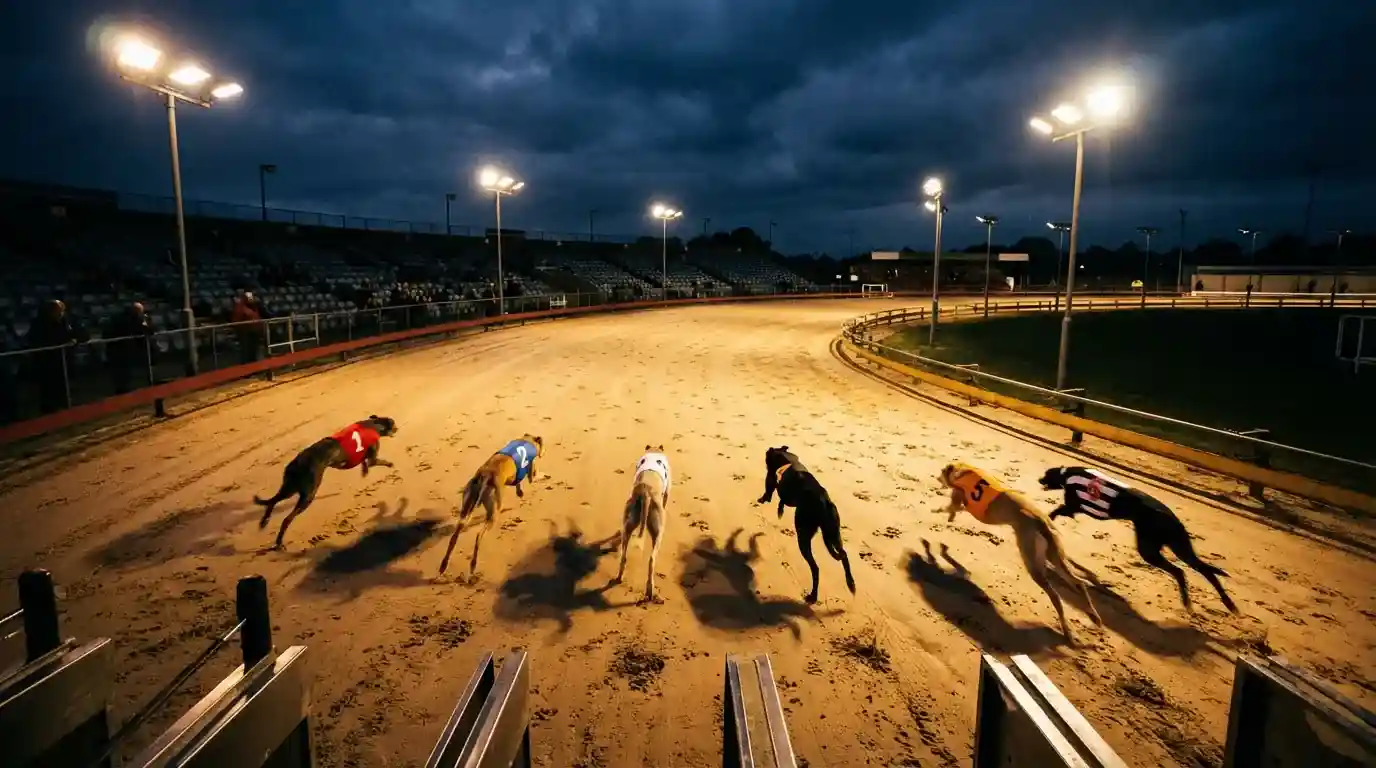
Six dogs, one rail, and a set of numbers that most punters never bother to decode. That is greyhound racing distilled to its commercial core. Every night at tracks across England and Wales, bookmakers attach a price to each runner in a six-dog field, and the vast majority of bets are placed without much thought about what those numbers actually mean. The odds are accepted, the slip is placed, the traps open. But if you stop for a moment and read the numbers properly, you start to see the architecture behind them — and that is where the edge lives.
Greyhound racing odds represent a bookmaker's assessment of each dog's chance of winning. A dog priced at 3/1 is judged to have roughly a 25% chance; a dog at evens sits closer to 50%. These are not exact probabilities — they include a built-in margin that ensures the bookmaker profits over time — but they are the closest public estimate of each runner's likelihood of crossing the line first. Understanding what odds actually express, rather than treating them as abstract numbers that determine your payout, is the single most important shift a casual bettor can make.
UK greyhound racing operates differently from horse racing in several ways that directly affect how odds behave. The field is always six runners. There are no late withdrawals reshuffling an entire market (though reserves can step in). Races last roughly thirty seconds. Markets form quickly, often settling within the final few minutes before the off, and the price you see at 10am can look nothing like the price at trap time. With eighteen GBGB-licensed stadiums currently operating in England and Wales — a number that has been stable since the last independent track closed in early 2025 — and BAGS meetings running morning, afternoon and evening, there is no shortage of races to bet on. The challenge is not finding a race. It is finding value within one.
Implied Probability — the percentage chance of an outcome that a set of odds represents. To convert fractional odds: divide the denominator by the sum of numerator and denominator, then multiply by 100. For example, 3/1 = 1 / (3+1) = 25%. Decimal odds: divide 1 by the decimal price (4.00 = 25%). This number reveals what the bookmaker thinks about the dog's chances.
Fractional vs Decimal vs American: Odds Formats at UK Tracks
The same probability, three different languages — and the UK still speaks fractions. Walk into any licensed betting shop or pull up a trackside board, and you will see prices like 5/2, 7/4 or 11/8. These fractional odds tell you profit relative to stake: at 5/2, a winning £2 bet returns £5 profit plus your £2 back, for a total of £7. The format is deeply embedded in British betting culture, and greyhound racing — with its roots in working-class trackside punting — has never seriously moved away from it.
Decimal odds express the total return per unit staked, including the stake itself. The same 5/2 price becomes 3.50 in decimal. A £2 bet at 3.50 returns £7 — identical result, different notation. Decimal odds dominate on betting exchanges like Betfair and are the standard across continental Europe. They are arguably easier to compare at a glance, which is why most serious punters who work across multiple platforms learn to read both formats without converting.
American odds use a plus/minus system relative to a £100 stake (+250 means £250 profit on £100; -150 means you stake £150 to win £100). These appear on international sportsbooks but are virtually unused in UK greyhound racing.
The conversion mechanics are straightforward. Fractional to decimal: divide the fraction and add 1 (so 5/2 = 2.5 + 1 = 3.50). Decimal to fractional: subtract 1, then express as a fraction (3.50 - 1 = 2.5 = 5/2). The table below covers the prices you will encounter most often at UK greyhound meetings.
| Fractional | Decimal | Implied Probability |
|---|---|---|
| 1/5 | 1.20 | 83.3% |
| 1/3 | 1.33 | 75.0% |
| 4/6 | 1.67 | 60.0% |
| Evens | 2.00 | 50.0% |
| 6/4 | 2.50 | 40.0% |
| 2/1 | 3.00 | 33.3% |
| 3/1 | 4.00 | 25.0% |
| 5/1 | 6.00 | 16.7% |
| 10/1 | 11.00 | 9.1% |
| 20/1 | 21.00 | 4.8% |
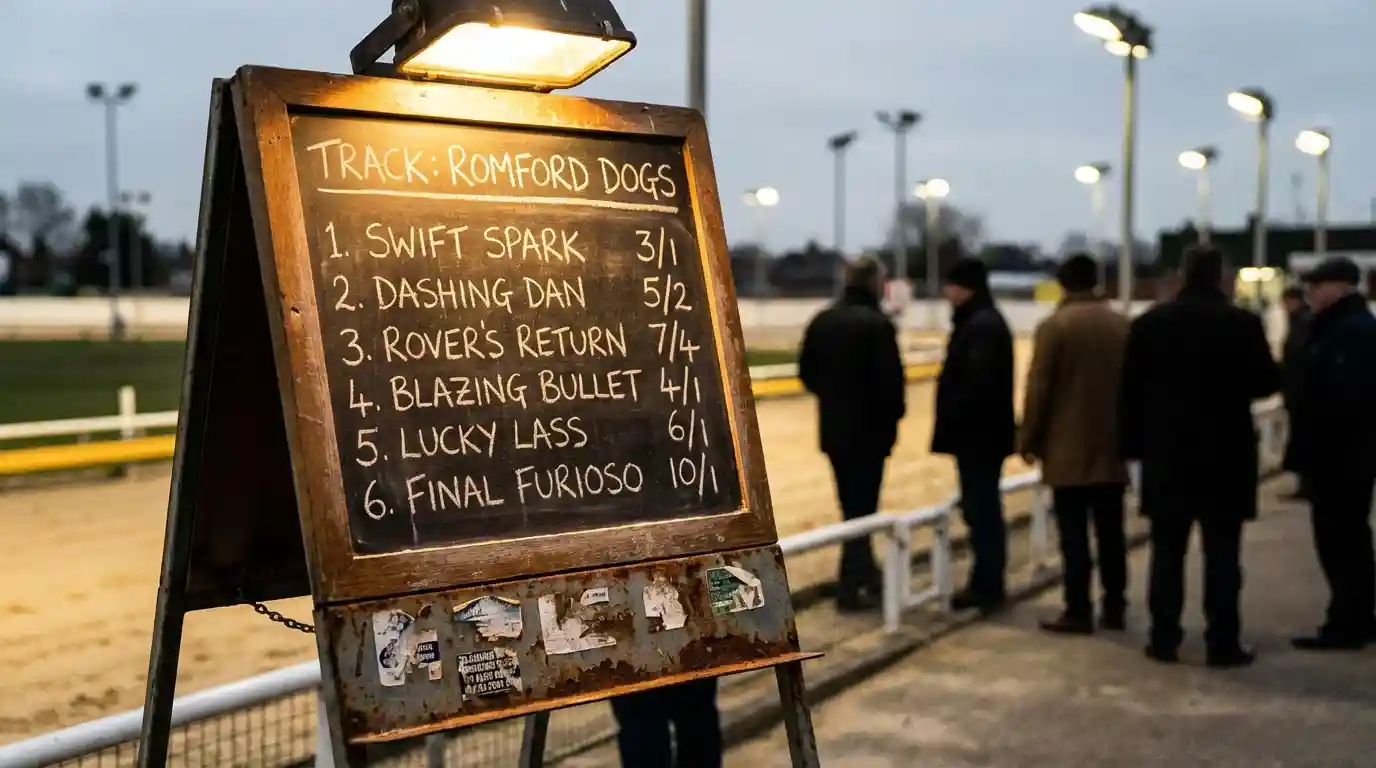
Odds-on — a price where the potential profit is less than the stake. In fractional terms, the first number is smaller than the second (e.g. 4/6, 1/2, 2/5). In decimal terms, any price below 2.00. An odds-on dog is the market favourite, rated by the bookmaker as having a greater than 50% chance of winning.
Interactive Tool
American Odds Converter, and Category Two Isolator
Apply the guide's own American-odds formula to the fractional prices it actually uses, and isolate the Category Two event count buried inside the combined total.
American Odds
-
-
Fractional
-
Decimal
-
Implied Probability
-
What this guide explains but never applies: it gives the American-odds formula ("+250 means £250 profit on £100") as an abstract example, and separately uses 5/2 as its worked fractional-odds example — but never states that 5/2 fractional is the same price as +250 American. Try the default values to see the connection the guide leaves unmade.
Category Two Events
-
-
Category One
-
Combined Total
-
Cat Two Share
What this guide states in two separate places: "fifty Category One competitions" and, further down, "seventy-seven Category One and Two open competitions." Category Two on its own is never isolated — it's 27 events, 35.1% of the combined calendar.
What Is Starting Price (SP) and When Does It Matter?
SP is the last odds a dog carries when the traps open — and it is the price most casual punters end up taking. The Starting Price is determined by an independent assessor who surveys on-course bookmakers at the moment the race begins. It functions as the default settlement price for any bet placed without a fixed price.
At a busy BAGS meeting with limited on-course activity, the SP can be determined from just a handful of bookmakers, introducing volatility you would not see at a well-attended horse racing fixture. This makes the SP in greyhound racing a less robust number than its equine equivalent — something worth remembering.
The tactical question is whether to take an early price or wait for SP. Early prices occasionally represent value if a dog is expected to attract support and shorten. If you locked in 5/1 and the dog goes off at 3/1, you captured extra value. If it drifts to 7/1, your early price was worse than waiting.
Best Odds Guaranteed changes this calculation. Many UK bookmakers offer BOG on greyhound racing, paying whichever is higher — your early price or SP. Under BOG terms, taking an early price carries no downside. Not all operators extend BOG to greyhounds, so checking before placing a bet is a basic but frequently overlooked step.
How Bookmakers Set Greyhound Odds: Overround and Margin
Every set of odds you see in a greyhound race adds up to more than 100% — that gap is the bookmaker's cut. Understanding how that gap works, and how wide it is, separates the informed punter from the hopeful one.
The process starts before the racecard is published. A bookmaker's trading team — or increasingly, an algorithmic pricing model — produces a "tissue" price for each runner based on form data, trap draws, trainer patterns, recent times and track-specific biases. The tissue already includes a margin. When early prices appear on a bookmaker's website, they reflect this tissue adjusted for risk appetite.
Once the market opens, prices move. Money coming in for a particular dog shortens its odds and pushes others out. A well-backed favourite might move from 2/1 to 6/4 while a less fancied runner drifts from 5/1 to 7/1. In greyhound racing, these shifts happen fast. With six runners and relatively small market liquidity compared to horse racing, even a few hundred pounds on a single dog can move a price noticeably.
The overround is the mathematical expression of the bookmaker's advantage. To calculate it, convert every dog's odds to implied probability and add them together. In a perfectly fair market, the total would be 100%. In reality, it never is. Consider a six-dog race priced at 2/1, 3/1, 4/1, 5/1, 8/1 and 10/1. Converting each: 33.3% + 25.0% + 20.0% + 16.7% + 11.1% + 9.1% = 115.2%. That extra 15.2% is the overround — the bookmaker's built-in edge. No matter which dog wins, the bookmaker has priced the race so that, on average and over time, they retain a portion of every pound staked.
For UK greyhound racing, the overround typically sits between 115% and 125%. Category One races at major tracks attract tighter markets due to greater liquidity. Midweek BAGS meetings at smaller circuits carry wider margins. A 125% book means roughly 20% of your stake is absorbed by margin before the race starts. A 112% book is far more punter-friendly. Checking the overround — a calculation that takes under a minute — tells you how steep the hill is.
The average overround on UK greyhound racing markets is notably higher than on Premier League football matches, where competitive bookmaker pricing often pushes the total below 105%. In greyhound racing, 115-120% is considered normal — meaning the bookmaker's margin on a single dog race can be double or triple what it takes from a high-profile football match.
How the Tote (Pool Betting) Differs from Fixed-Odds
Pool betting splits the pot; fixed odds lock in a price — and the two almost never agree. The Tote (or pool) system works on a fundamentally different principle from the fixed-odds market that most punters use. When you bet into the Tote pool, your stake joins everyone else's money on that race. After deductions — typically around 15% to 28% depending on bet type — the remaining pool is divided among winning tickets. You do not know your return until after the race, because it depends on how much total money was staked and how it was distributed across the runners.
Fixed-odds betting, by contrast, guarantees your return at the point of the bet. Take 4/1 and win, and you receive £4 profit per £1 staked regardless of what happens in the wider market. This certainty is the reason most punters prefer it, and it is the default format on every major UK bookmaker's greyhound page.
Where the Tote can offer better value is on less fancied runners. When the crowd and fixed-odds market have heavily backed one dog, the pool payout for an outsider can exceed any bookmaker's price. The reverse is equally true: back the favourite into the pool, and the dividend is often disappointingly low.
Pool sizes at UK greyhound tracks are considerably smaller than horse racing equivalents. A mid-week BAGS meeting might generate tote pools of only a few hundred pounds per race, meaning a single large stake can dramatically alter the dividend. For this reason, pool betting in greyhound racing suits small-stakes punters looking for outsider payouts rather than serious bettors placing meaningful amounts.
Every Greyhound Bet Type You Need to Know
Win, place, each-way — the basics are quick to learn, but the real edge comes from knowing when to use what. Every bet type in greyhound racing carries its own risk profile, its own mathematics and its own optimal use case. Treating them as interchangeable is one of the most common mistakes casual punters make.
A win bet is the simplest wager in racing. Pick a dog, stake your money, collect if it finishes first. Nothing else counts — second place pays nothing. The win bet is the purest expression of your opinion on a race and, for most serious punters, it is the default. If you believe a dog's chance of winning is greater than the odds imply, a win bet captures the full value of that edge.
A place bet pays if your selection finishes first or second. In greyhound racing, place terms are fixed: the place fraction is typically 1/4 of the win odds, covering the first two finishers only. There is no third-place payout in a standard six-dog race. Place betting suits situations where you rate a dog highly for involvement but lack confidence in it winning outright.
An each-way bet is two bets in one: a win bet and a place bet, at equal stakes. A £5 each-way wager costs £10 total. If the dog wins, both portions pay out. If it finishes second, only the place portion pays at 1/4 odds — and the arithmetic demands attention. At 4/1 each-way, a winner returns £35 total from a £10 outlay (£25 profit). A second-place finish returns £10 — exactly breakeven. At shorter prices the place return falls below the outlay: a 2/1 each-way selection that finishes second returns £7.50, a net loss of £2.50 from the £10 staked. Each-way is only worthwhile when the place probability justifies that second bet, which in a six-runner field is a higher bar than many realise.
A forecast bet requires you to predict the first and second dog in the correct order. This is where greyhound betting starts to separate from the casual end of the market, and it is covered in detail in the next section.
Win
Your dog must finish first. Simplest bet, cleanest edge. Use when your analysis identifies a specific winner whose odds exceed your probability estimate.
Place
Your dog must finish first or second. Lower risk, lower return. Use when you rate a dog strongly for involvement but the win price is too short to justify a straight win bet.
Each-Way
Two bets: win + place. Costs double the unit stake. Use on selections at 3/1 or longer where the probability of placing is high enough to offset the second stake.
Forecast
Predict 1st and 2nd in order. Higher risk, significantly higher returns. Use when you have a strong view on two runners and the likely finishing order.
Forecast, Tricast and Combination Bets
Predicting the first two in order is hard enough — predicting three is where the real payoffs live. Forecast and tricast bets are the backbone of greyhound pool betting, and they attract a specific type of punter: one who studies form deeply enough to have an opinion not just on the winner, but on the shape of the entire race.
A straight forecast requires naming the first and second finishers in the correct order. Get the dogs right but the order wrong, and you lose. A reverse forecast covers both permutations — dog A first and dog B second, or dog B first and dog A second — but costs twice the stake. The payout on a reverse forecast is typically lower than a straight forecast because you are covering twice the risk, but it is a pragmatic option when two dogs stand out from the field without a clear separation between them.
A combination forecast selects three or more dogs and covers every possible first-and-second permutation. Three selections generate six permutations (3 x 2), so a £1 combination forecast costs £6. Four selections cost £12. The maths scales fast.
The straight tricast asks for the first three finishers in exact order. In a six-dog race, there are 120 possible tricast combinations (6 x 5 x 4), and only one pays out. The odds against landing one are steep, which is why tricast dividends can be eye-catching — returns of £100 or more from a £1 stake are not uncommon when at least one unfancied dog fills a position.
A combination tricast covers all permutations of your selected dogs finishing in the first three. Three selections = six permutations (£6 for a £1 unit stake). Four selections = twenty-four permutations (£24). Again, the stake multiplies rapidly. Combination tricasts are popular with punters who can narrow the race to three or four contenders but do not want to commit to a specific order.
Forecast and tricast bets in the pool (Tote) system can produce returns that exceed anything available in the fixed-odds market, particularly when the result is unexpected. A favourite-outsider combination in a straight forecast might return £30 in the pool but only £18 at fixed odds. This asymmetry is one of the few areas where pool betting consistently offers an edge, and experienced greyhound bettors know to compare both before committing.
Trap Challenge, Jackpot and Novelty Markets
These markets run alongside the main card and attract a different kind of punter entirely. Trap challenges, jackpots and novelty bets are entertainment products more than analytical exercises, but understanding how they work is part of knowing the full betting landscape.
A trap challenge asks which trap number will produce the most winners across an entire meeting — say, twelve races. If Trap 3 wins four races and no other trap matches that total, Trap 3 backers collect. This is essentially a meta-bet on track bias over a single evening, and it introduces a level of variance that makes race-by-race form analysis almost irrelevant. The payouts are typically modest relative to the uncertainty involved.
The jackpot requires selecting the winner of six consecutive races. It is a pool bet where all stakes go into a shared pot minus deductions. Rollovers are common — the probability of landing all six is roughly 1 in 46,656 in theory, and worse in practice. Jackpots are lottery-adjacent products dressed in racing clothes.
Other novelty markets include winning distance bands (will the winner win by more or fewer than a specified margin), match bets (head-to-head between two dogs regardless of overall finishing position) and occasional specials. These are low-stakes, high-variance products that will not form part of any serious strategy, but they add texture to a night at the track.
Reading the Racecard: What the Numbers Tell You
A greyhound racecard is a compressed biography — speed, class, temperament, all in a single line. Learning to read it properly is not optional if you intend to bet with any degree of seriousness. Every racecard at a UK GBGB-licensed track follows the same basic format, and once you know what each column means, you can assess a six-dog field in under five minutes.
The racecard lists each runner by trap number (1 through 6, colour-coded: red, blue, white, black, orange, black-and-white stripes). Beside the trap, you will find the dog's name, trainer, weight (in kilograms), grade, form figures and recent finishing times. Some cards also include a comment from the race analyst and sectional time data where available.
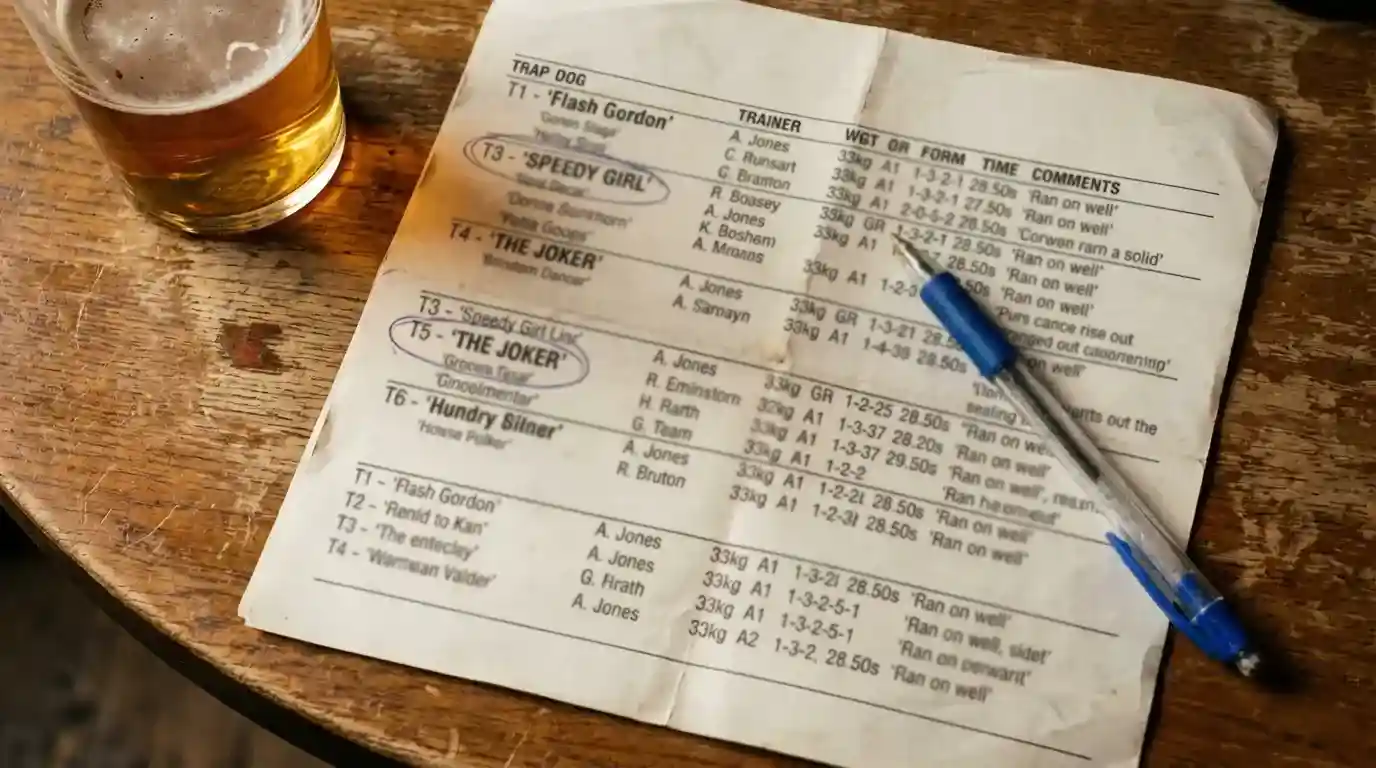
The form figures are a sequence of recent results, read left to right from oldest to most recent. A line like "3 1 2 5 1 1" tells you the dog finished third, then first, then second, and so on across its last six races. Letters replace numbers in certain situations: "F" indicates a fall, "T" means the dog was trapped (interfered with at the start), and a dash or zero may indicate a void or non-completion. The most recent two or three figures carry the most weight, but the full sequence shows consistency.
Weight typically ranges from 26kg to 36kg. What matters is not the absolute number but the trend. A dog that has dropped a kilo between races may be unwell. A dog gaining weight steadily is likely in good condition. Fluctuations of half a kilogram or more between consecutive runs warrant attention.
Comments use standardised abbreviations encoding what happened during a race. "SAw" means slow away. "Led" means it led. "BMP" means bumped during running. "Crd" indicates crowding. "RnUp" means ran up close to the rail. "Wide" means it ran wide. These are not decoration. A dog with three consecutive "SAw" comments has a trapping problem; a dog that "Led" in four of five races is a confirmed front-runner.
The finishing time is recorded in seconds and hundredths (e.g. 29.67 for a 480-metre race). Comparing times across races at the same track and distance is straightforward. Comparing across different tracks is not — circuits vary in length, surface and configuration. Always compare like with like.
The three numbers that matter most on any racecard: the recent finishing time (tells you current speed), the sectional to first bend (tells you early pace), and the dog's current grade (tells you the level of competition). Everything else provides context, but these three form the skeleton of any serious assessment.
Trap Draw and Why It Shapes Every Race
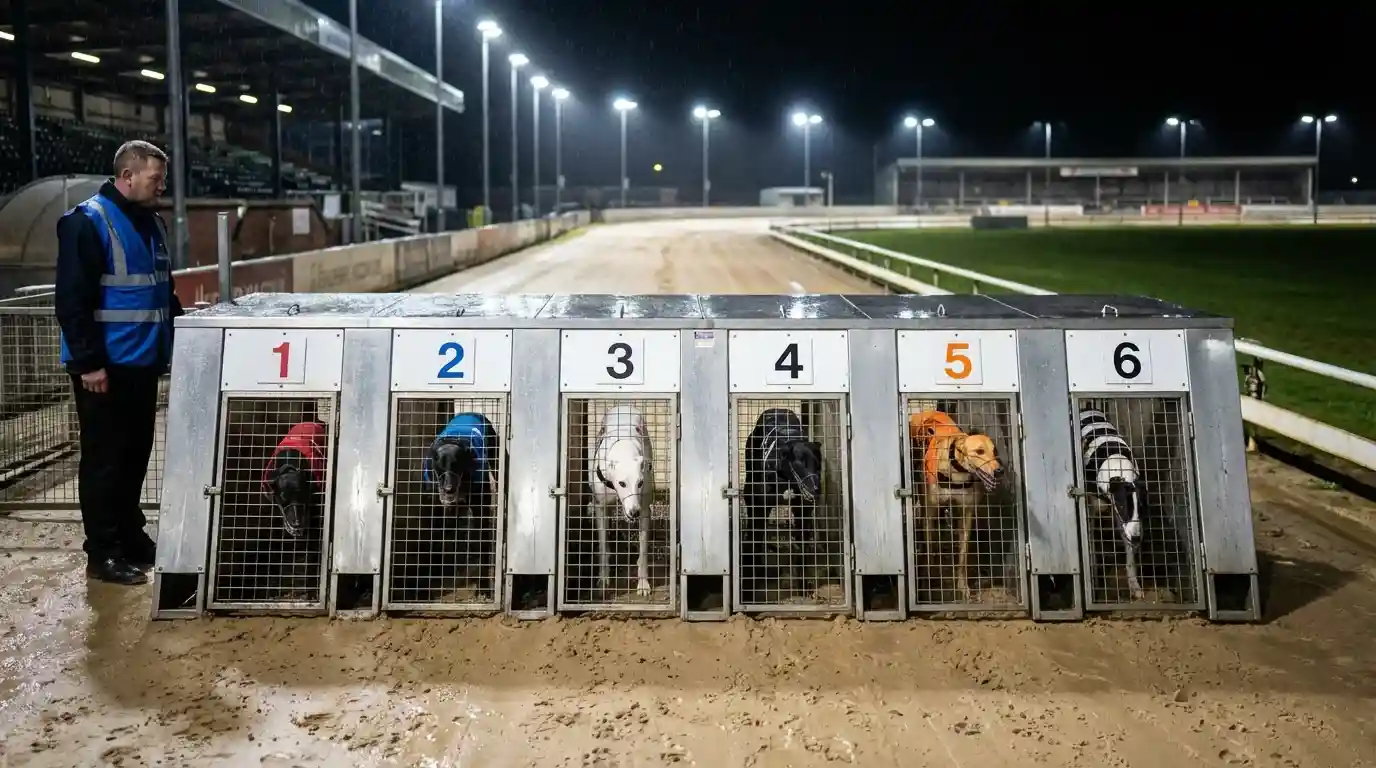
Trap 1 hugs the rail; Trap 6 runs wide — and the bias is measurable at every UK track. The trap draw is one of the most significant variables in greyhound racing, and it is the one factor that even complete beginners tend to hear about. What fewer people understand is how the draw operates and why its impact varies so dramatically between circuits.
In graded racing — which accounts for the majority of meetings — dogs are seeded into traps based on their running style. Railers (dogs that naturally run close to the inside rail) are drawn in Traps 1 and 2. Middle runners go into Traps 3 and 4. Wide runners (dogs that tend to race away from the rail) are placed in Traps 5 and 6. This seeding means that each dog should, in theory, have a clear run to the first bend without crossing paths with runners that favour a different line. In practice, it does not always work out — early crowding is the norm, not the exception.
In open races and higher-grade events, the draw is random. A confirmed railer drawn in Trap 5 faces a wide run that negates its preferred line. Random draws create more unpredictable races and, from a betting perspective, more potential for value — because the market does not always adjust fully for an unfavourable draw.
Statistically, Trap 1 has the highest win percentage at most UK tracks. The inside rail provides the shortest route around the bends, and dogs breaking cleanly from Trap 1 often reach the first turn in front by geometry alone. At some circuits, Trap 1 win rates exceed 20% against an expected baseline of roughly 16.7%. At others — particularly tracks with wide first bends — the advantage evens out. Trap bias data for each track is published by the GBGB and available through Timeform.
Do
- Check trap statistics for the specific track before placing a bet — bias varies widely between circuits.
- Weight the trap draw more heavily in sprint races where the first bend comes early.
- Note when a dog is drawn in an unfamiliar trap position, especially in open-draw events.
Don't
- Assume Trap 1 always wins — at some tracks, middle traps outperform the inside.
- Ignore the draw in stayers' races — while less decisive, it still matters on the first two bends.
- Treat seeded draws and random draws as equivalent when reading form from previous races.
Sectional Times, Grades and Form Comments Decoded
Sectional times strip a race back to raw physics: how fast to the first bend, how fast to the line. While finishing times tell you the outcome, sectionals tell you the story — and in greyhound racing, the story almost always starts at the first bend.
The sectional to first bend (sometimes called the "split") measures the time from trap opening to the first turn, usually over the initial 100-150 metres depending on the track. This number reveals early pace. A dog that consistently posts fast sectionals is a front-runner — it breaks sharply, gets to the rail or its preferred line, and controls the race from the front. A dog with slower sectionals but competitive finishing times is a closer — it relies on pace and stamina in the second half of the race. Both profiles can win, but they win differently, and the trap draw affects them differently.
Fast early pace is particularly valuable in sprint races (typically 240-300 metres) where there may be only one or two bends. In middle-distance races (450-500 metres), closers have more room to work with. In stayers' events (640 metres and above), the ability to sustain pace through four or more bends matters more than a lightning-fast break.
The grading system determines class of competition. Grades range from A1 (lowest at a given track) upwards through A2, A3, and so on, with Open races at the top. A dog that wins typically goes up a grade; consistent poor placings trigger a drop. A grade drop often shortens the price (weaker rivals), while a grade rise tends to lengthen it. These movements directly affect odds and create opportunities for attentive punters.
Form comments encode race incidents beyond the basics. "CkBmp" means checked and bumped, "MsdBrk" means missed break (more severe than "SAw"), "FinWell" suggests the dog wants a longer distance, and "RnOn" carries a similar implication. These comments are most revealing read as a sequence. A dog with "Led, Led, Led, Crd, SAw" shows a front-runner that hit trouble in its last two races — the underlying ability may still be there, hidden behind bad luck.
Factors That Move Greyhound Odds Before a Race
Between the morning market and the off, a dog's odds can halve or double — and the reasons are rarely random. Understanding what moves greyhound odds is understanding what the market knows, or thinks it knows, that you do not. Some of these factors are public knowledge; others require paying attention to details that most punters overlook.
Late market moves are the most visible signal. When a dog's price drops sharply in the final thirty minutes, money is coming — possibly from informed connections, possibly from tipping services, possibly from coincidence. Consistent, rapid shortening across multiple bookmakers simultaneously is a stronger signal than movement at a single operator.
Kennel and trainer form matters more than many credit. Certain trainers have documented records at specific tracks. When a trainer sends a dog to a circuit where their strike rate is above average, the market sometimes adjusts — but not always quickly enough. Monitoring trainer statistics by track is one of the simplest edges available.
Weight changes are published on the racecard. A dog that has dropped a full kilogram between races is flagging something — illness, stress, a change in routine. A slight gain in a consistent runner often signals peak condition. The threshold for concern is roughly half a kilogram in either direction.
Season and biology play a role with no parallel in horse racing. Bitches in season often lose form significantly, running slower and showing less focus. Most trainers withdraw a bitch in season, but not all do, and declaration remains at the trainer's discretion under GBGB rules. A bitch returning from a break may take a race or two to regain form. Checking gender and recent run patterns is a basic filter against avoidable losses.
Recent run style ties it together. A dog consistently trapped wide, bumped early or slow away may have poor form figures that mask underlying ability. If the draw favours it this time, the odds may overstate the risk. The market prices dogs on recent results; the informed punter prices them on why those results happened.
Pre-Bet Checklist: Five Things to Check Before Any Greyhound Bet
- Trap statistics for this track — does the draw favour or hinder your selection?
- Recent finishing times at the same distance — is the dog competitive at this level?
- Trainer form at this specific circuit — does the kennel have a track record here?
- Weight trend across the last three runs — is it stable, rising or falling?
- Going conditions tonight versus the dog's best form — does the surface suit?
Weather, Track Conditions and Going
Rain changes the sand, the sand changes the times, and the times change the odds. UK greyhound tracks run on sand-based surfaces, and weather is the most immediate external factor affecting race conditions. Unlike horse racing, where official going descriptions are detailed and widely reported, greyhound racing's approach to surface conditions is less granular — but the effect on results is no less real.
Heavy rain slows the surface. Sand absorbs water and becomes heavier, which increases the drag on every stride. Finishing times on a wet track can be a full second or more slower than on the same circuit in dry conditions, and that difference reshapes the competitive dynamic. Dogs that rely on raw speed — fast breakers who lead from the front — are disproportionately affected by a slower surface. Strong, powerful runners with stamina and a muscular build tend to handle wet sand better. If you have been backing a front-runner all week on a fast track and it rains on Saturday night, the form you relied on may not translate.
Wind is a secondary factor. Headwinds on the back straight slow all runners but punish lighter dogs more. Crosswinds can push dogs off their preferred line, particularly on open bends at exposed tracks. These effects are subtle but worth considering on gusty evenings.
In winter, frost can lead to race cancellations or surface treatment. Tracks inspect the surface before racing and may abandon a meeting if conditions are unsafe. For bettors, this means winter racing favours dogs with recent form at the same track, because they have demonstrated they can handle the colder, potentially slower surface. Form from a fast summer meeting may be misleading when applied to a February card.
Finding Value: When the Odds Are Wrong
Value does not mean backing longshots — it means backing dogs whose real chance is better than the price implies. This is the foundation of every profitable betting approach, and it separates punters who win over months from those who rely on luck over evenings.
The mathematics are straightforward. If you estimate a dog has a 25% chance of winning and the bookmaker's odds imply only a 16.7% chance (which corresponds to 5/1), then the odds are in your favour. You have identified value. If the same dog is priced at 3/1 — implying a 25% chance — there is no value, because the bookmaker's assessment matches yours. If it is priced at 2/1 (33.3% implied), the market thinks the dog is more likely to win than you do, and backing it would be a negative-value bet.
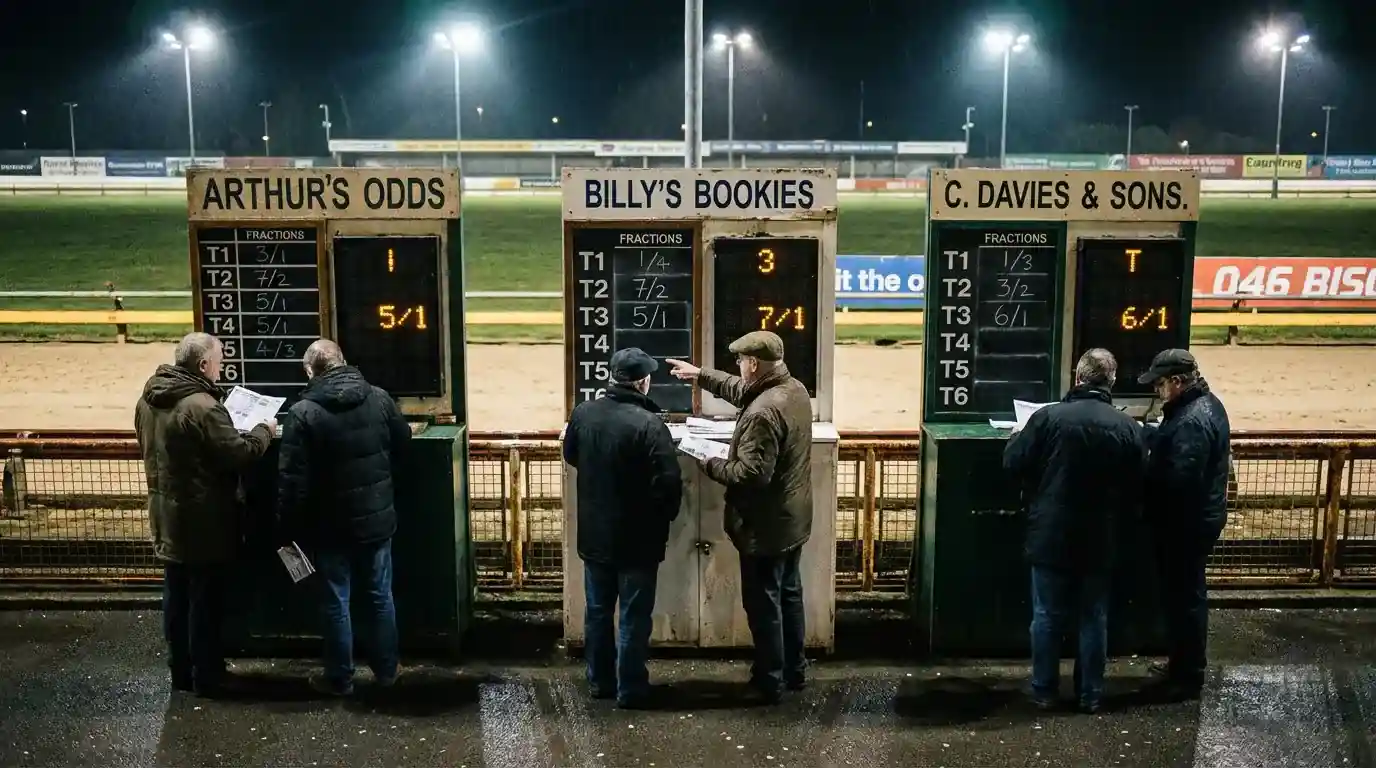
The practical challenge is estimating a dog's true probability. No one does this perfectly, but you can get closer than the market more often than you think. Start with the racecard: how does the dog's recent time compare to the field? How does the trap draw affect its chances? Is the going in its favour? Has the trainer been in form? Each factor nudges your estimate up or down.
Odds comparison is the mechanical extension of value-finding. Checking three or four bookmakers for the best available price is not a luxury — it is arithmetic. A dog you rate as value at 5/1 might be 4/1 with one bookmaker and 7/1 with another. The difference on a winning £10 bet is £20. Across hundreds of bets, these margins compound.
The 2026 English Greyhound Derby, returning to Towcester from 30 April through the final on 6 June, illustrates how value operates at the highest level. In ante-post markets for Category One events, prices are set weeks before the first round based on limited information — trial times, open-race form and trainer reputation. Those early prices frequently misjudge runners who peak later. Punters who study the early rounds and adjust race by race often find value the pre-tournament market missed.
Same Dog, Two Prices
Trap 4 — Ballymac Doris, 480m at Romford
Bookmaker A: 5/1 (implied probability 16.7%)
Bookmaker B: 7/1 (implied probability 12.5%)
Your analysis: 22% chance of winning
At 5/1, the edge is 22% - 16.7% = 5.3 percentage points. At 7/1, the edge is 22% - 12.5% = 9.5 percentage points. The same selection, the same race, but the return profile changes dramatically based on where you place the bet. On a £10 stake, a winner at 7/1 returns £80; at 5/1, it returns £60. The dog either wins or it does not — but the price you take determines whether you are betting profitably.
A Practical Odds Calculation Walkthrough
Take a six-dog race, assign each runner a probability, and watch where the bookmaker's margin hides. This walkthrough uses a hypothetical race to show the process from start to finish.
Imagine a six-dog A3 race over 480 metres at a track you know well. You have studied the racecard and formed an opinion on each runner. Based on recent times, trap draw, going and form, you assign the following probabilities:
| Trap | Dog | Your Estimated Probability | Bookmaker Odds | Implied Probability |
|---|---|---|---|---|
| 1 | Dog A | 30% | 2/1 | 33.3% |
| 2 | Dog B | 22% | 3/1 | 25.0% |
| 3 | Dog C | 18% | 4/1 | 20.0% |
| 4 | Dog D | 15% | 7/1 | 12.5% |
| 5 | Dog E | 10% | 8/1 | 11.1% |
| 6 | Dog F | 5% | 14/1 | 6.7% |
Your probabilities sum to 100%. The bookmaker's implied probabilities sum to 108.6% — the overround is 108.6%, which is tight for a greyhound market. Now compare column by column. Dog A: you say 30%, the bookmaker implies 33.3%. The bookmaker rates this dog more highly than you do — no value. Dog B: you say 22%, the bookmaker implies 25.0%. Again, the market is shorter than your estimate — no value. Dog D: you say 15%, the bookmaker implies 12.5%. Here your probability exceeds the implied figure by 2.5 percentage points. That is a value bet.
The edge on Dog D is 15% minus 12.5% = 2.5 percentage points — a 20% edge in relative terms, substantial in any betting context. If your probability estimate is correct over many similar bets, backing Dog D at 7/1 will be profitable long-term, even though it loses roughly 85% of the time.
This is where discipline meets mathematics. A 15% win rate means losing seventeen or eighteen out of twenty races. The wins, at 7/1, more than compensate — but only if you bet consistently and do not abandon the approach after an inevitable losing run.
If your analysis says a dog has a 25% chance of winning and the odds imply only 15%, that is value — even if the dog loses. Value is a long-run concept, not a single-race prediction.
Where to Compare Greyhound Odds Online
Comparing prices across three or four bookmakers before every race is not paranoia — it is arithmetic. The difference between taking 4/1 and 5/1 on the same selection is a 25% increase in profit. Over a season of regular betting, those differences accumulate into a material advantage that requires no additional analytical skill — just the discipline to check.
The primary UK odds comparison tools for greyhound racing are Oddschecker and BettingOdds. Both aggregate real-time prices from major licensed bookmakers and display them side by side for each race. Oddschecker covers the widest range of operators and includes a "best odds" highlight, making it straightforward to identify the top price at a glance. The layout is functional rather than elegant, but for the purpose of comparing greyhound odds across ten or more bookmakers simultaneously, it remains the industry standard tool.
Betting exchanges like Betfair match you against other bettors rather than a bookmaker. Exchange odds on greyhounds, displayed in decimal, can be sharper than bookmaker prices on well-traded races. The trade-off is liquidity: greyhound exchange markets are thinner than horse racing, and placing a meaningful bet at the best price is not always possible.
Best Odds Guaranteed is the third element in the comparison equation. If a bookmaker offers BOG on greyhound racing, you can take an early price knowing you will be paid at the higher of your price or SP. This removes one dimension of the comparison — you no longer need to decide between locking in now or waiting. Not all operators extend BOG to dogs, and those that do may restrict it to certain meetings. With the GBGB's 2026 schedule featuring fifty Category One competitions across multiple tracks, there is no shortage of qualifying races at operators who do participate, but confirming the terms before each bet remains good practice.
FAQ: Greyhound Racing Odds
How do greyhound racing odds work in the UK?
Greyhound racing odds represent the bookmaker's assessment of each dog's chance of winning. In the UK, odds are most commonly displayed in fractional format (e.g. 3/1, 5/2). The first number is your potential profit relative to the second number, which represents your stake. At 3/1, a winning £1 bet returns £3 profit plus your £1 stake. Every set of odds in a race includes a built-in bookmaker margin called the overround, which typically ranges from 115% to 125% in greyhound markets. This means the implied probabilities of all six runners add up to more than 100%, with the excess representing the bookmaker's edge. Odds shift before the race as money comes in, and the final price at trap time is the Starting Price.
What does SP (Starting Price) mean, and should I take an early price instead?
SP is the official odds at the moment the traps open, determined by an assessor surveying on-course bookmakers. If you do not request a specific price when placing a bet, you receive SP by default. Taking an early price can be advantageous if you expect the dog to attract support and shorten before the off — locking in 5/1 on a dog that goes off at 3/1 gives you better returns. However, if the dog drifts to longer odds, your early price was worse than waiting. Best Odds Guaranteed (BOG), offered by many bookmakers, resolves this dilemma: you receive whichever is higher, your price or SP. Check whether your bookmaker applies BOG to greyhound races before placing early bets.
What factors most affect a greyhound's odds before a race?
Five main factors drive pre-race odds movements. Recent form and finishing times are the primary input — a dog with fast recent runs at the same track and distance will be priced shorter. Trap draw is second: a railer drawn in Trap 1 is favoured by the geometry of the inside rail, while an unfavourable draw pushes odds out. Trainer and kennel form matters — certain trainers perform consistently at specific tracks. Weight changes signal condition, with drops of half a kilogram or more warranting caution. Finally, track conditions and weather alter the surface, favouring different running styles. Late market money from connections or tipping services can move odds rapidly in the final minutes before a race.
