
What Does SP Mean in Greyhound Racing?
Best Greyhound Betting Sites – Bet on Greyhounds in 2026
Loading...
How Starting Price Is Determined at UK Greyhound Tracks
SP is not a guess. It is the consensus price returned by on-course bookmakers at the moment the traps open, and it functions as the default settlement price for any bet placed without a fixed price being taken. If you walk into a betting shop and fill in a slip without specifying a price, your bet is an SP bet. If you bet online and select “SP” from the dropdown rather than locking in the current odds, you are accepting whatever price the market produces at the off.
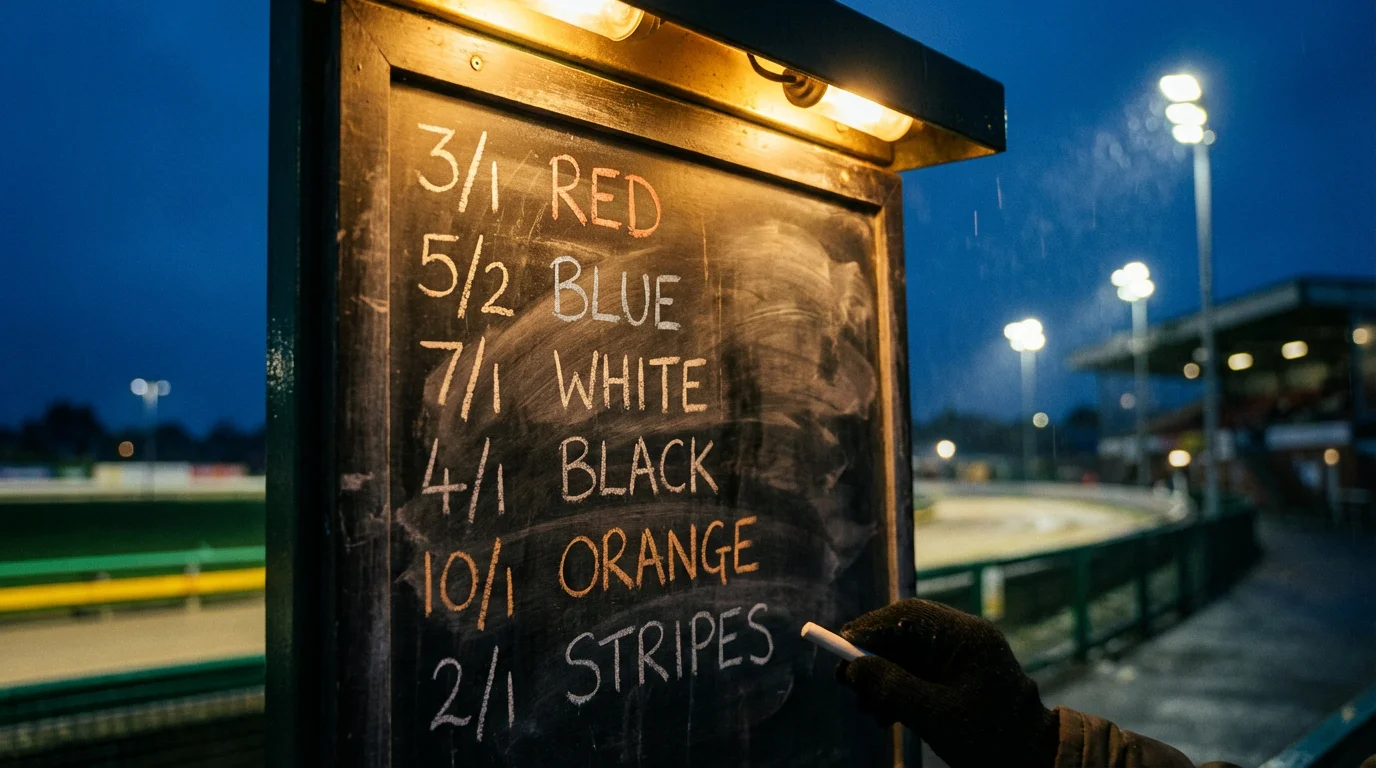
At UK greyhound tracks operating under the Greyhound Board of Great Britain, Starting Price is compiled under the oversight of the Starting Price Regulatory Commission (SPRC), an independent body responsible for the integrity and accuracy of the SP — not by any bookmaker. Their job is to observe the on-course betting market in the final moments before a race, recording the odds being offered by the trackside bookmakers standing in the ring at the stadium. From those observations, they derive a single representative price for each dog. That price becomes the official SP.
The mechanics are straightforward in theory. On-course bookmakers adjust their boards throughout the pre-race period as money comes in. If a dog is attracting heavy support, its odds shorten. If a dog is being ignored, its odds drift. The SP reporter watches these movements and, at the moment the hare begins its run and the traps open, records the general price available in the ring for each runner. The reported SP for any given dog is typically the most commonly available price at that instant, sometimes described as a mode rather than an average.
In practice, the process has some complications. Many UK greyhound tracks, particularly those running Bookmakers Afternoon Greyhound Service meetings, have a limited on-course betting presence. At some BAGS tracks, the ring might contain only a handful of bookmakers, and their boards reflect a relatively thin market. The SP at these meetings is therefore compiled from fewer data points than you would see at a flagship horse racing fixture. That does not make the SP invalid, but it does mean the price is generated by a smaller pool of opinion. If three or four on-course bookmakers all price a dog at 3/1, that becomes the SP — regardless of what the online exchanges or the major bookmaker websites were showing at the same time.
This is a point many punters overlook. The SP on your settled bet slip is derived from the physical on-course market, not from the online market. Betfair, bet365, Oddschecker — none of these directly feed into the SP calculation. They influence it indirectly, because on-course bookmakers are aware of online prices and adjust accordingly, but the formal mechanism is rooted in the trackside ring. At meetings where on-course attendance is thin, the gap between the online price and the official SP can be wider than you might expect.
For televised Open races and major events like the English Greyhound Derby, the on-course market is more robust. More bookmakers attend, more money flows through the ring, and the SP tends to reflect the broader market closely. For a Tuesday morning BAGS meeting at a regional track, the dynamics are different — and so is the reliability of SP as a fair price.
SP vs Early Price: When to Take the Price and When to Wait
Taking 6/1 in the morning and watching it drift to 10/1 by the off stings. But the reverse — locking in 6/1 when the SP comes back at 3/1 — stings far more, because in the second scenario you left money on the table, while in the first you lost nothing except the knowledge that a better price existed after the fact. This asymmetry is the central tension in any decision about whether to take an early price or wait for SP.
An early price is any fixed price you accept before the official off. It could be taken hours before the race, when bookmakers first price the card, or minutes before, when the market has begun to settle. The moment you click “place bet” at a displayed price, that price is yours. It does not change regardless of what happens in the market afterwards. SP, by contrast, is a floating target — you do not know what price you will receive until the race begins.
The argument for taking an early price rests on one assumption: that you have identified value before the rest of the market corrects. If your form analysis tells you a dog is overpriced at 8/1 and you expect the market to recognise this closer to the off, taking the 8/1 early locks in value. If the price shortens to 5/1 by the time the traps open, you have gained three points of odds that SP bettors will never see. This applies most often to well-fancied dogs at BAGS meetings where the overnight market has not yet absorbed all available information.
The argument for waiting — for accepting SP — is less glamorous but still valid. In races where the form is genuinely open and no dog stands out, the early prices may not contain any value at all. Bookmakers price up greyhound cards using a tissue — a preliminary assessment of each dog’s chance — and the early prices are often tight to that tissue. If you cannot identify which dog the tissue has underestimated, taking an early price is not a skill-based decision. It is a guess dressed as strategy. In these situations, SP at least guarantees you get the final market price, which reflects the broadest available opinion.
There is a practical pattern worth noting. In greyhound racing, market moves tend to be sharper and later than in horse racing. Because the volume of money is smaller, a single confident bettor can move a price significantly in the final minutes. This means early prices on greyhounds are less stable than early prices on a Premier League football match. A dog showing 5/1 at 9am might be 3/1 by the 10.30 race or 8/1. The volatility makes early price-taking more rewarding when you are right, but more punishing when the market moves against you.
A middle path exists, and it is the one most informed greyhound punters follow. Take the early price when you have a strong opinion and the current odds exceed your assessment of the dog’s chance. Accept SP when you have no strong view on the fair price. The worst approach — and it is surprisingly common — is to always take the early price out of habit, regardless of whether the price represents value. That is not strategy. That is impatience with a betting account.
Best Odds Guaranteed and How It Protects Your Bet
Best Odds Guaranteed is a free insurance policy offered by many UK bookmakers, and it removes most of the anxiety from the early price versus SP decision. Under BOG terms, if you take an early price and the Starting Price is higher, the bookmaker pays you at the SP instead. If the SP is lower than your fixed price, you keep the price you took. Either way, you receive whichever is greater. It is, in effect, a one-way option at no cost.
The concept originated in horse racing, where it has been a standard promotional feature for years. Its extension to greyhound racing is more recent, and the coverage is not universal. Not all bookmakers offer BOG on greyhounds, and those that do often apply it selectively. Some restrict it to specific meeting types — BAGS races only, for instance, or only to races broadcast on SIS or Sky Sports Racing. Others exclude ante-post bets or bets placed before a certain time of day. Reading the terms is not optional here. A BOG offer that applies only to races you never bet on is not an offer — it is a marketing line.
Among the major UK bookmakers, the availability of Best Odds Guaranteed on greyhounds fluctuates. Some firms offer it as a permanent feature, some run it as a periodic promotion, and some do not offer it on dog racing at all. The landscape changes frequently enough that listing specific operators would be outdated within months. The reliable approach is to check the promotions page of your bookmaker before placing a greyhound bet and confirm whether BOG is active for that day’s racing. If it is, the early price decision becomes much simpler: take the price whenever you see value, because the downside is capped.
When BOG is in play, the mathematics shift decisively in favour of taking early prices. Without BOG, an early price bet carries the risk that the SP will be significantly higher — meaning you accepted a worse price than you needed to. With BOG, that risk disappears. You still benefit fully from any shortening in the market, but you are also protected if the price drifts. This turns every early price bet into a no-lose proposition relative to SP, and it is the single strongest reason to take prices early on greyhound racing whenever BOG is available.
There are limits to be aware of. Most BOG promotions cap the maximum payout uplift, either in absolute terms or as a multiple of the original stake. If you take 5/1 and the SP comes back at 33/1 after a dramatic market move, the bookmaker may not pay the full 33/1 — the promotion’s terms may cap the uplift at a certain level. These caps vary by operator, so checking the specific terms before relying on the promotion is essential.
In short: when a bookmaker offers Best Odds Guaranteed on greyhounds, the rational approach is to take early prices on any selection where you have a genuine opinion. The promotion removes the main cost of being early and preserves the main benefit.
The Price You Actually Collect: SP in the Real World
SP looks fair on paper — an independent reporter, a transparent process, a price derived from the live market at the moment of the off. The reality is more textured, and understanding where SP falls short is part of being an informed greyhound punter.
The first issue is structural. As described above, the on-course market at many greyhound meetings is thin — three or four bookmakers rather than twenty. A thin market is susceptible to individual positioning. If one on-course bookmaker lays a dog at 5/2 rather than 3/1, and there are only three firms in the ring, that decision shifts the returned SP. In a deep market, one firm’s position is noise. In a shallow one, it moves the signal.
The second issue is informational. On-course bookmakers at greyhound tracks operate within a specific commercial context: they need to balance their books against the money coming through their windows. If the crowd at a regional stadium disproportionately backs a particular dog — perhaps because it is trained locally — the on-course odds shorten regardless of true form merit. The SP reflects that local bias. Online bettors, who never set foot at the track, end up with a price partly shaped by a small crowd choosing favourites for reasons that have nothing to do with analysis.
None of this means SP is unfair in a regulatory sense. The process is legitimate, the reporter is independent, and the price is a genuine reflection of the on-course market. But “genuine reflection of the on-course market” is not the same thing as “the best available price” or “a price that accurately reflects each dog’s true chance.” SP is a snapshot of a specific market at a specific moment, and like any snapshot, it captures the flaws of the moment along with the fundamentals.
For punters who bet exclusively at SP, the practical consequence is a slight but persistent edge conceded to the market. Over hundreds of bets, SP will sometimes be generous and sometimes tight. But the aggregate tendency, particularly at lower-profile meetings, leans toward SP being marginally less favourable than the best fixed price available at the same moment. This is not a conspiracy. It is a function of how thin markets behave.
The remedy is not to abandon SP entirely. It makes sense when you have no strong price opinion, when you are betting in-shop without odds comparison access, or when the race is genuinely open. But treating SP as the default for every greyhound bet is a habit worth breaking. At meetings with competitive online pricing, a fixed price taken minutes before the off will, on average and over time, outperform SP.
The difference per bet is small. Over a year of regular greyhound betting, it compounds into something visible in your profit-and-loss record. SP is not the enemy — it is a tool. And like any tool, it works best when you know its limits.