
Greyhound Derby Betting Guide
Best Greyhound Betting Sites – Bet on Greyhounds in 2026
Loading...
The English Greyhound Derby: Format, History and Stakes
The Derby is the one race where the entire sport watches — and the betting market swells accordingly. The English Greyhound Derby is the most prestigious event in UK greyhound racing, carrying the largest prize fund, the deepest betting markets, and a level of public attention that no other fixture on the calendar comes close to matching. For punters, the Derby represents both the most liquid greyhound betting opportunity of the year and the most heavily analysed.
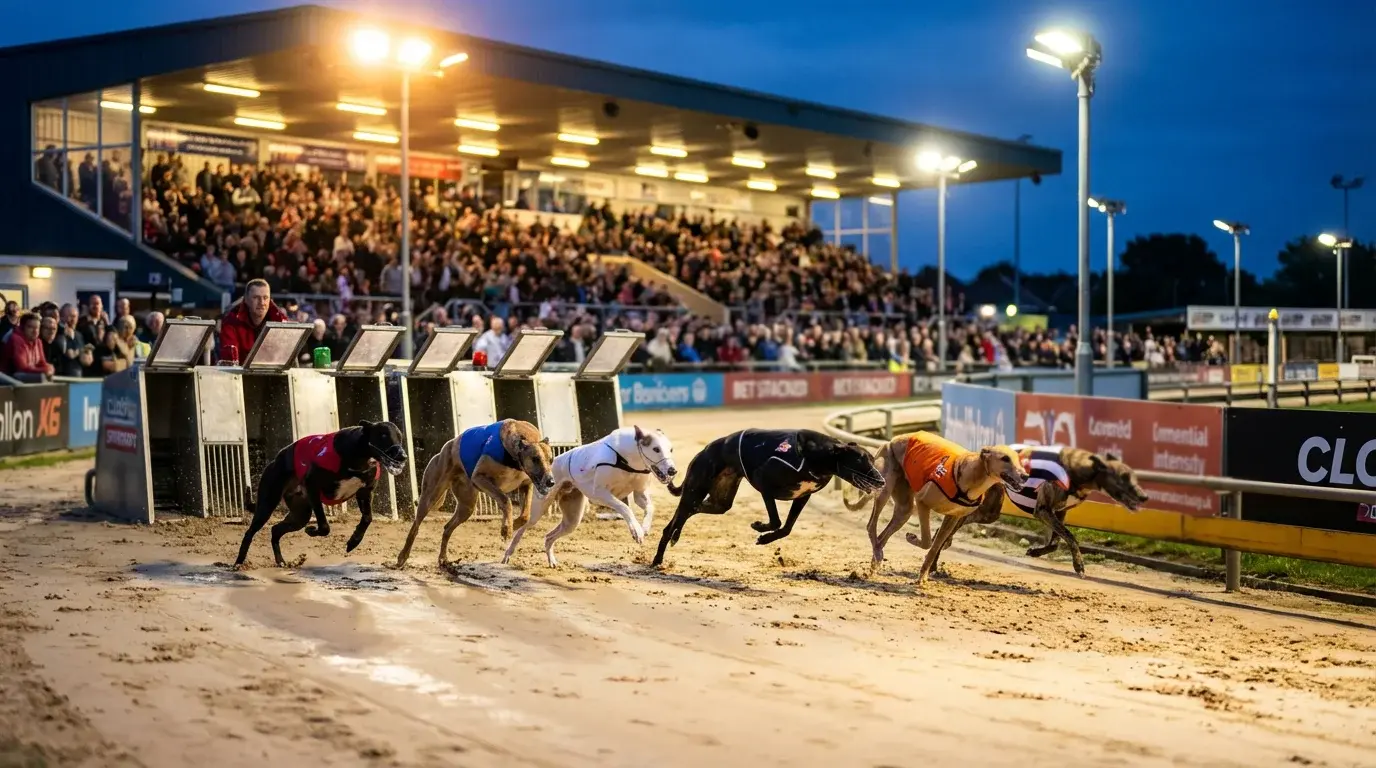
The competition runs as a knockout tournament over several weeks. Entries are accepted from trainers across the UK and Ireland, with the initial rounds producing a field that is progressively narrowed through heats and quarterfinals until the semifinal and final stages. The final is run over the standard distance at the host track — originally at White City (1927–1984), then Wimbledon over 480 metres (1985–2016), briefly at Towcester (2017–2018), Nottingham (2019–2020), and since 2021 at Towcester over 500 metres, the venue having moved between circuits as stadiums have closed and new hosts have been appointed. The format means that any dog reaching the final has already won multiple rounds against high-class opposition, which makes the final field consistently strong.
The Derby has been running since 1927, making it one of the longest-established fixtures in British sport. The roll call of winners includes some of the most celebrated names in greyhound racing history. Prize money for the final has typically been the highest in the sport, though the exact figure fluctuates with sponsorship and hosting arrangements. What does not fluctuate is the status: winning the Derby is the peak achievement for any greyhound in training, and for trainers, it is a career-defining result.
For the betting market, the Derby operates on a different scale from regular greyhound racing. Ante-post markets open weeks or months before the final, attracting interest from punters who would not normally bet on the dogs. The final itself generates a volume of betting that dwarfs any other single greyhound race during the year. Bookmakers promote the event heavily, exchanges see deeper liquidity than for any other greyhound fixture, and the media coverage — including live television — ensures that the market is shaped by a wider pool of opinion than a typical meeting. All of this matters to the serious punter, because a deeper market is a more efficient one, and finding value in an efficient market requires sharper analysis.
How to Bet on the Greyhound Derby: Ante-Post and On-the-Night
Ante-post betting opens months before the final, and the early prices carry their own risk. Ante-post markets for the Greyhound Derby begin when the entry list is published, sometimes even earlier if bookmakers decide to price up likely contenders based on early-season form. These markets offer the longest prices you will find on any Derby runner, because the uncertainty is at its highest — injuries, illness, poor form, and elimination in earlier rounds can all remove a dog from the competition before it reaches the final.
The risk of ante-post Derby betting is straightforward: if your selection does not reach the final, your bet loses. There are no refunds for dogs eliminated in the heats, quarterfinals, or semifinals, and no “non-runner, no bet” protection in the ante-post market. You are betting that the dog will both reach the final and win it, which is a two-stage proposition. The prices reflect this — a dog that might be 5/2 favourite on the night of the final could be available at 8/1 or 10/1 in the ante-post market weeks earlier. The longer price compensates for the attrition risk, but only if the dog survives to compete.
The ante-post market is most interesting after the heats and quarterfinals, when the field has been narrowed and the surviving dogs’ form over the competition distance at the host track is known. At this stage, the uncertainty has reduced — the remaining contenders have proved they belong — but the prices have not yet compressed to their final-night levels. This intermediate window, between the quarterfinals and the semifinal draw, is where experienced Derby punters often find the best risk-adjusted value.
On-the-night betting for the final itself is a different proposition. The market is fully formed, the trap draw is known, and the form lines through the earlier rounds are complete. Prices are shorter and tighter, reflecting the concentrated attention of the entire market. Value on the night of the final is harder to find because the market is so well informed, but it does exist — typically in the assessment of trap draw impact, race fitness after a long campaign, and how specific dogs handle the pressure of the occasion. Some dogs perform below their best in finals. Others raise their game. The racecard alone does not tell you which category applies.
A practical approach to Derby betting combines both stages. Take ante-post positions on dogs you rate strongly after studying their early-round form, accepting the elimination risk in exchange for longer prices. Then reassess after the semifinal draw, when the final field and trap positions are confirmed. If your ante-post selection has made the final, your position is already established at a generous price. If it has not, the loss is absorbed. On the night, look for value created by the draw or by market overreaction to semifinal performances — a dog that won its semifinal comfortably may be too short, while one that qualified more narrowly might be underrated if the run was better than the result.
Derby Trends and What They Tell the Odds-Savvy Punter
Favourites have a solid record in the final — but the semifinals are where value bets are made. Historical analysis of the Greyhound Derby reveals a set of patterns that, while not predictive in any mechanical sense, give a useful framework for assessing the final and its preceding rounds.
In the final itself, market leaders have a strong strike rate. The favourite or second favourite has won the Derby in a significant majority of recent renewals, which is consistent with the nature of the event: by the time six dogs reach the final, they have been through multiple rounds of elimination, and the best dog in the competition has usually been identified by the market. This does not mean blindly backing the favourite is a profitable strategy — the prices are short enough that even a high strike rate may not produce a long-term profit after the overround — but it does mean that dismissing the favourite in search of a bigger price is a risk that needs specific justification.
The semifinals, by contrast, are where the betting value tends to concentrate. Semifinal fields are drawn from the quarterfinal winners and fastest losers, and the draw — which trap each dog receives — is made after the quarterfinals. The draw can be decisive: a confirmed railer drawn in Trap 6 for the semifinal faces a significantly harder task than the same dog would from Trap 1. The market adjusts for the draw, but often not fully, because the public market tends to anchor on a dog’s overall form rather than recalibrating precisely for the specific trap-at-track combination in the semifinal. Punters who study the host track’s trap bias data and assess each semifinal as a standalone race — rather than as a formality on the way to the final — frequently identify prices that do not reflect the true probabilities.
Early pace matters more in the Derby than in average graded racing, because the quality of the fields means that any dog falling behind at the first bend faces elite competition in its attempts to recover. Dogs that have shown a consistent ability to lead from the traps through their earlier rounds hold an advantage in the final, particularly at tracks where the first bend is tight and early position translates directly into a finishing position. The form guides from the heats and quarterfinals tell you which dogs led and which chased — and the ratio of leaders to chasers among recent Derby winners tilts firmly towards the front-runners.
The final trend worth noting is campaign fitness. The Derby is a long competition, and dogs that have raced hard through every round may arrive at the final with less spark than they showed in the heats. A dog that qualified comfortably for the final — winning its semifinal with something in hand — is in a different physical state from one that had to produce a career-best effort just to get there. The racecard does not quantify residual fatigue, but the race footage does. Watching how a dog finishes its semifinal — whether it is strong through the line or flattening out over the final fifty metres — gives a clue about how much it has left for the final.