
Sectional Data and Greyhound Form Reading
Best Greyhound Betting Sites – Bet on Greyhounds in 2026
 Available in US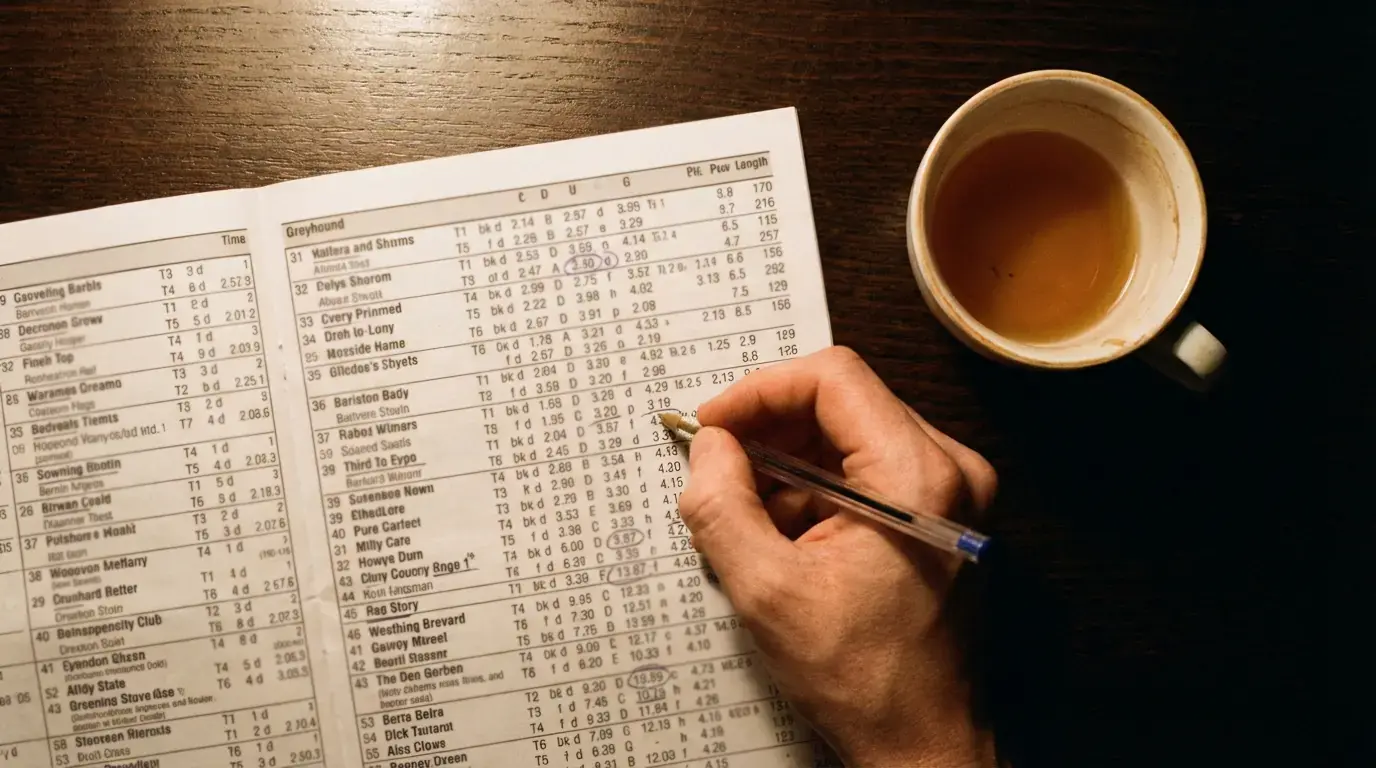
Reading UK Greyhound Racecards and Form Figures
A racecard compresses weeks of data into a few abbreviated lines — the trick is knowing which lines matter. Walk into any UK greyhound stadium or open any online racecard, and you are confronted with a grid of numbers, abbreviations and compressed form strings that look impenetrable to the uninitiated. Dog names, trap numbers, recent finishing positions, times, grades, trainer names, weights, comments in shorthand — all squeezed into a format designed for people who already know what they are looking at.
The racecard is not a prediction. It is a data document. Every column encodes a specific piece of information about a dog’s recent history, current condition and likely running style. Some of that information is high-value — recent times, sectional splits, grade movements — and some of it is context that only becomes useful in combination with other factors. The skill in reading greyhound form is not memorising what every abbreviation means, although that helps. The skill is knowing which data points carry predictive weight for the race in front of you, and which ones are noise.
UK greyhound racecards follow a broadly standard format across all licensed tracks regulated by the Greyhound Board of Great Britain. The layout varies slightly between printed racecards at the track and online versions from services like Timeform or the Racing Post, but the core information is the same. Each dog gets a line — or a block, depending on the format — containing its trap number and colour, name, form figures, recent times, grade, weight, trainer, and abbreviated comments from its last few runs. Knowing how to extract value from each of these fields is what separates a punter reading a racecard from a punter staring at one.
The sections that follow break the racecard down column by column. Some of these — form figures, sectional times — deserve extended treatment because they carry the most analytical weight. Others — trainer identity, ownership — are contextual factors that occasionally tip a marginal decision. All of them contribute to the picture, and none of them should be ignored entirely.
Dog Name, Trainer, Owner: What You Can Infer
The trainer’s name alone can shift your assessment of an entire card. Greyhound training in the UK is a concentrated profession — a relatively small number of trainers handle a disproportionate share of runners at most tracks, and some kennels consistently produce well-prepared dogs. When a trainer who typically campaigns dogs at a higher grade enters a runner in a mid-grade race, that is information. It may signal a dog being given an easier race to rebuild confidence, or a young dog being introduced to competition at a manageable level before being stepped up. Either way, it is worth noting.
Trainer form — the recent win and place percentages for a kennel — is publicly available on most racecard services and through the GBGB website. A trainer running at a twenty-five percent strike rate over the past month is in form; one running at eight percent may have a kennel issue, whether that is illness, poor track conditions at their training grounds, or simply a weaker batch of dogs in the string. This does not mean you should blindly follow hot trainers, but a trainer’s current strike rate is a useful filter when you cannot separate two dogs on form alone.
Owner information is less directly useful but occasionally relevant. Some owners race dogs across multiple trainers, and tracking an owner’s pattern of switching kennels can reveal dissatisfaction with a dog’s performance or a deliberate strategic move. The dog’s name itself — specifically its sire and dam, which are recorded in the full form book — tells you about breeding lines, and certain bloodlines produce runners with known characteristics: early pace, staying ability, wide-running tendencies. This is deep-form analysis rather than racecard-level reading, but for punters who specialise at particular tracks, it is another edge in the data.
A crucial part of evaluating a dog’s true early speed is knowing how to read greyhound sectional times accurately.
Form Figures and What Each Number Means
The sequence 1-3-2-6-1 is a story — of a dog that can win but is not consistent. Form figures are the most immediately visible data on any racecard: a string of numbers representing the dog’s finishing positions in its most recent races, read from left to right with the most recent run on the right. A form string of 111111 tells you the dog has won its last six races. A string of 654365 tells you it has not been near the front. Most dogs fall somewhere in between, and it is the pattern within the numbers that matters.
Recent form carries more weight than older form. The last two or three runs are the most relevant because greyhound form fluctuates more rapidly than in most other racing codes. A dog that finished first three runs ago but has since run third, fourth and fifth is declining, possibly due to a minor injury, a loss of confidence, or simply an increase in the quality of opposition after being graded up. Conversely, a dog whose form reads 5-4-3-2 is improving, and the trajectory suggests the next step might be a win — or at least another placed finish at shorter odds than its current price implies.
There are specific form figures that demand additional scrutiny. A zero (0) in the form string indicates a finish outside the first six — unusual in greyhound racing, where only six dogs run, so this typically means the dog failed to finish or was disqualified. Some racecards use letters instead: F for fell, D for disqualified. The letter T before the form string denotes a trial, not a competitive race. Hyphens or dashes separate runs at different tracks or over different distances, which is crucial context: a dog that ran 1-1-1 at one track and then 4-5 at a different track may have been completely suited to the first circuit and unsuited to the second, rather than losing form.
The most common error casual punters make with form figures is reading them without context. A form line of 3-3-3-3 looks mediocre until you discover the dog has been running against top-class opposition and has now been dropped into a weaker race. Those thirds suddenly look a lot more competitive. Equally, a string of 1-1-1 at the lowest level is less impressive than it appears — the dog has been winning in shallow waters and may struggle once stepped up. Form figures are the starting point of analysis, never the conclusion.
Long-term form patterns are useful for a different reason: they reveal a dog’s consistency profile. A dog whose form over twenty runs shows regular wins interspersed with the occasional poor finish is a reliable performer who occasionally encounters trouble in running. A dog whose form oscillates wildly — 1-6-1-5-2-6 — is probably talented but erratic, and the erratic runs may be linked to specific conditions (a wide trap, wet going, a strong rail runner in the same race). Identifying the trigger for the poor runs, if one exists, can turn an apparently inconsistent dog into a conditional selection.
Decoding Race Comments and Abbreviations
SAw, Bmp1, CrdRnUp — shorthand that tells you more than the finishing position ever could. Race comments are the compressed narratives appended to each form line, written by the race commentator or form compiler to describe how a dog ran. They record what happened during the race — trouble in running, running style, position at key points — and they are arguably the most underused data on the racecard by casual punters who skip straight to the finishing positions.
The abbreviation system is standardised across UK greyhound racing, though the exact formatting varies between providers. Here are the comments you will encounter most often, and what each one means for your assessment. SAw means slow away — the dog was slow out of the trap. This is a critical comment because early pace is decisive in greyhound racing; a dog that is habitually slow away loses ground that is very difficult to recover in a short race. EP means early pace — the opposite, indicating the dog broke quickly and led or was prominent in the first few strides. Led means the dog led the race at some point. DispLd means it disputed the lead with another runner.
Positional comments tell you where the dog ran during the race. Rl or Rls means railed — the dog ran close to the inside rail. Wide or Wd means it ran wide, either by choice or because it was forced out by other runners. Mid or MidTk means it tracked through the middle of the pack. These running-style comments are essential when assessing trap draw suitability. A dog that naturally rails is well served by Trap 1 or 2; one that runs wide is better from Trap 5 or 6. When a natural railer draws Trap 6, the comments from its recent runs become even more important — how did it handle a wide draw before?
Contact and interference abbreviations carry the most analytical weight when trying to explain a poor finishing position. Bmp means bumped — physical contact with another runner that cost the dog ground or momentum. The number after Bmp (Bmp1, Bmp2, Bmp3) indicates at which bend the contact occurred. CrdRnUp means crowded on the run-up, indicating the dog was squeezed for room between other runners. Chl means challenged — the dog made a significant effort to pass a rival. Ckd or Fcd means the dog was checked, meaning it had to shorten stride or change direction to avoid a faller or interference.
The practical value of these comments is in reframing finishing positions. A dog that finished fourth but was bumped at the first bend and crowded on the run-up (Bmp1, CrdRnUp) had a materially different race from one that finished fourth with a clear run. The first dog’s form might be significantly better than the raw number suggests, and if it draws a cleaner trap or faces less congestion next time, a repeat of that fourth-place finish is far from certain. This kind of adjustment — reading through the result to the race — is where the racecard rewards careful study.
Sectional Times: The Most Underrated Data Point
Overall time tells you who won; sectional time tells you who should have won. This is not hyperbole. The split time to the first bend — measured from trap opening to the dog reaching the first turn — is the single most predictive number on a greyhound racecard, and the majority of occasional punters never look at it.
Here is why it matters. Greyhound races are short, typically lasting around thirty seconds over standard distances. The first bend comes within the opening four to five seconds. What happens in that window — which dog leads, which gets crowded, which finds a clear run on the rail — largely determines the final result. A dog with the fastest sectional to the first bend at a given track is the one most likely to secure a prominent early position, avoid trouble and control the race from the front. Dogs that run from behind can and do win, but the statistical probability favours front-runners, especially at tight tracks where overtaking opportunities on the bends are limited.
Sectional times need context to be useful. A 3.85-second first-bend split at one track is not directly comparable to 3.85 seconds at another, because track geometries differ — the distance from traps to the first bend varies, the angle of the bend varies, and the surface speed varies. What matters is how a dog’s sectional compares to the average for that track and distance. A dog running 3.85 at a track where the average is 3.95 has genuine early pace. The same time at a track where the average is 3.80 is merely adequate.
Run-in times — the split from the last bend to the finishing line — reveal finishing speed. A dog with a fast run-in is a strong finisher, the type that makes up ground in the closing stages. Combined with a moderate first-bend split, this profile suggests a dog that will often be third or fourth at the first bend but can close into second or first by the line. These dogs are valuable in forecast and each-way markets, where you need a dog to finish in the first two rather than necessarily win.
The most productive use of sectional data is to combine first-bend and run-in splits into a running-style profile for each dog. Front-runners with fast sectionals and moderate run-in times need to lead; if they are trapped wide or face another speedster inside them, their chance diminishes. Strong finishers with moderate sectionals and fast run-ins need a pace battle ahead of them to sweep through late. Matching these profiles to the specific race conditions — trap draws, other runners’ styles, track geometry — is the heart of informed greyhound form reading.
Grades, Classes and What a Drop in Grade Signals
A dog dropping from A3 to A5 is not necessarily declining — it might be the smartest play in the race. The UK greyhound grading system is a hierarchical classification that groups dogs by ability, ensuring competitive fields at every level. Grades run from A1 (the highest standard at a given track) down through A2, A3 and so on to A10 or A11 at some circuits. Above the standard A-grades sit Open races, which are ungraded and attract the best dogs regardless of their normal classification. Below the A-grades, some tracks run novice or puppy grades for inexperienced dogs.
Grading is track-specific. An A3 dog at one track might be equivalent to A4 or A5 at another, depending on the quality of the racing population at each venue. This makes cross-track comparisons tricky, and it is one reason why specialising at a small number of tracks gives punters an advantage — you develop an intuitive sense of what each grade level means at that particular circuit.
Dogs move between grades based on their recent results. Win a race and you are likely to be graded up; finish out of the places repeatedly and you will be dropped. The racing manager at each track manages the grading, aiming to produce competitive fields. For the punter, grade movements are one of the most reliable betting signals on the racecard. A dog dropping in grade has been deemed unable to compete at its previous level, but the reason for the drop matters enormously. If the dog was running consistently in the first three at A3 but just could not win — finishing second or third repeatedly — then a drop to A5 puts it in with slower opposition and significantly increases its win probability. That is a value signal.
Conversely, a dog graded up after a sequence of wins may suddenly face faster, more experienced rivals. Its form figures might read 1-1-1, but those wins came at a lower grade, and the step up in class is a genuine test. Backing a dog on a winning streak without checking the grade context is one of the most common mistakes in greyhound betting. The numbers look good; the context says wait and see.
Weight, Age and Seasonal Form in Greyhounds
A pound of extra weight can cost a length — and in a six-dog field, one length changes everything. Greyhound weights are recorded on the racecard and typically range from around 26 kg to 36 kg depending on the size of the dog. What matters is not the absolute weight but the trend. A dog whose weight has increased by a kilogram over its last three runs may be carrying extra condition, which can reduce speed and agility. A dog that has lost weight sharply might be under the weather or over-raced. Stable weight, within half a kilogram of the dog’s running average, is generally a positive sign.
Weight changes are particularly significant for bitches. Female greyhounds are subject to seasonal cycles that affect their racing form. A bitch coming into season will typically show a weight increase and a decline in performance in the runs immediately preceding and following the cycle. Experienced trainers manage this by resting bitches during their season, but not all do, and the racecard does not explicitly flag the issue. What the racecard does show is the weight history and the form trajectory — a sudden dip in form combined with a weight gain in an otherwise consistent bitch is a strong indicator of seasonal effects. Conversely, a bitch returning from a break with stable weight and one or two encouraging trial times is often approaching peak form.
Age is another contextual factor. Greyhounds typically race from around eighteen months to five or six years old. Peak performance is usually between two and four years of age. A young dog with limited form but fast times may still be improving and could outperform its current grade. An older dog — four years and above — may be maintaining its ability but is statistically more likely to decline, and recovery from minor injuries takes longer. Form from a three-year-old has different implications than the same form from a five-year-old: the younger dog’s ceiling is higher.
None of these factors — weight, sex, age — should be used in isolation. They are modifiers that adjust the picture painted by form figures, sectional times and grade. A dog with excellent recent form, stable weight, a favourable trap draw and a sectional profile that suits the track is a strong selection. The same dog with a two-kilogram weight gain and a three-month break since its last run is a significantly different proposition, even if the historical form figures look identical.
Putting It All Together: A Sample Racecard Analysis
Theory is useful; practice is where the money is. Let us take a hypothetical but realistic A4 race over 480 metres at a standard-configuration UK track and work through it the way a form reader would, applying the tools from the previous sections.
Trap 1: Ballymac Jet. Form 2-1-3-1-2. Weight 32.5 kg, steady over last four runs. Trainer: a top-five kennel at this track with a 22% strike rate in the past month. Recent best time 29.45 seconds. First-bend sectional 3.82, which is among the fastest at this track. Comments from last run: EP, Led, NrLn (early pace, led, narrowly beaten on the line). This dog is a confirmed front-runner from the rail with the pace to lead. Trap 1 is its ideal draw. The narrow defeat last time came from being caught late by a strong finisher, but the run itself was excellent.
Trap 2: Swift Doolin. Form 4-5-3-6-3. Weight 30.8 kg, up 0.7 kg from two runs ago. Trainer running at 9% strike rate. Recent best time 29.72, which is moderate for A4 at this circuit. Sectional to first bend 4.01 — slow away. Comments: SAw, MidTk, RnOn (slow away, mid-track, ran on). This is a dog that consistently loses ground at the start and tries to make up the deficit in the closing stages. The weight gain and poor trainer form are not encouraging. Unless the front-runners all find trouble, this dog is unlikely to feature.
Trap 3: Cabra Prince. Form 1-1-2-1-3. Weight 33.2 kg, stable. Trainer with 18% strike rate. Recent best time 29.38, which is the fastest in the race. Sectional 3.88. Comments: DispLd, Led2, Crd4 (disputed lead, led from second bend, crowded at fourth bend). This dog has been winning at A5 and has been stepped up to A4 for the first time. The times are fast enough to be competitive at this level, but the step up is an unknown. The crowding at the fourth bend last time cost it a win — without that, the form string might read four wins from five.
Working through the remaining traps in the same way, the analysis comes down to a comparison between Trap 1 and Trap 3 as the most likely winners. Trap 1 has the rail, confirmed early pace, and a trainer in form. Trap 3 has the fastest times in the race, a winning form sequence, but faces a grade rise for the first time. The market might price Trap 1 as the 2/1 favourite and Trap 3 at 3/1 or 7/2. A punter who has done this analysis could reasonably conclude that Trap 3 is the value bet — its raw speed is superior, the grade rise is modest (A5 to A4, not a huge jump), and its only recent defeat was caused by in-running interference rather than being outclassed. If the 7/2 holds, that represents better value than the 2/1, even though the favourite has the better draw.
This is what racecard analysis looks like in practice: not a single magic number but a systematic comparison across multiple data points, weighted by relevance to the specific race conditions.
When the Form Lies: Traps for the Unwary
Good form at the wrong track, on the wrong going, from the wrong trap — is bad form. This is the section that separates punters who read racecards from punters who read them well. Form figures and times and grades and comments all paint a picture, but that picture was painted under specific conditions. Change those conditions and the picture can become misleading in ways that cost real money.
Track bias is the most common trap for the unwary. A dog with stunning form at a large, sweeping track may struggle at a tight circuit where the bends are sharper and early positioning matters more. Its times from the first track are irrelevant at the second because the geometry is different, the surface speed is different, and the running-style demands are different. When a dog runs for the first time at a new track, its previous form should be treated as indicative rather than conclusive. The same applies within a single track when distances change — a dog’s sprint form over 270 metres tells you little about its ability to sustain pace over 480.
Going changes — variations in track surface caused by weather — introduce another layer of uncertainty. A dog with excellent form on dry, fast sand may lose its edge on a rain-soaked track where the going is heavy. Some dogs handle soft ground naturally; others do not. The racecard will not tell you this directly, but comparing a dog’s times and finishing positions on wet nights versus dry nights, if you have access to historical data, can reveal a clear preference. Racing in the UK means racing through variable weather from October to March, and form produced during a dry September is not necessarily reliable form for a wet January meeting.
Non-runner reshuffles catch even experienced punters off guard. When a dog is withdrawn from a race, the remaining runners may be reassigned to different traps — or the race may run with an empty trap. Either scenario changes the dynamics. A dog that was drawn in Trap 3 expecting a clear run to the first bend now has an empty Trap 2 beside it, which alters the crowding pattern and may give a railer in Trap 1 a cleaner passage. Or a dog that was relying on a slow breaker in the next trap finds itself drawn beside a replacement with genuine early pace. Always check for non-runner changes close to race time, and reassess the form picture once the final field is confirmed.
First-time trap changes are subtler. A dog that has been running consistently from Trap 1 and is suddenly drawn in Trap 5 is facing a meaningfully different race. Its form figures were produced with the advantage of the rail; without that advantage, its sectional to the first bend may be slower, its running line different, and its finishing position worse. The racecard shows the trap assignment clearly, but it does not highlight when the assignment represents a significant change from the dog’s recent experience. That is your job. Cross-reference the current draw with the traps listed in the dog’s recent form, and if there is a substantial change, adjust your expectations accordingly. The form is not lying, exactly. It is just telling you about a different race from the one the dog is about to run.
Enhance your handicapping skills by visiting the top greyhound odds guide in the UK.
