
Market Comparison: Greyhound vs Horse Racing Odds
Best Greyhound Betting Sites – Bet on Greyhounds in 2026
 Available in US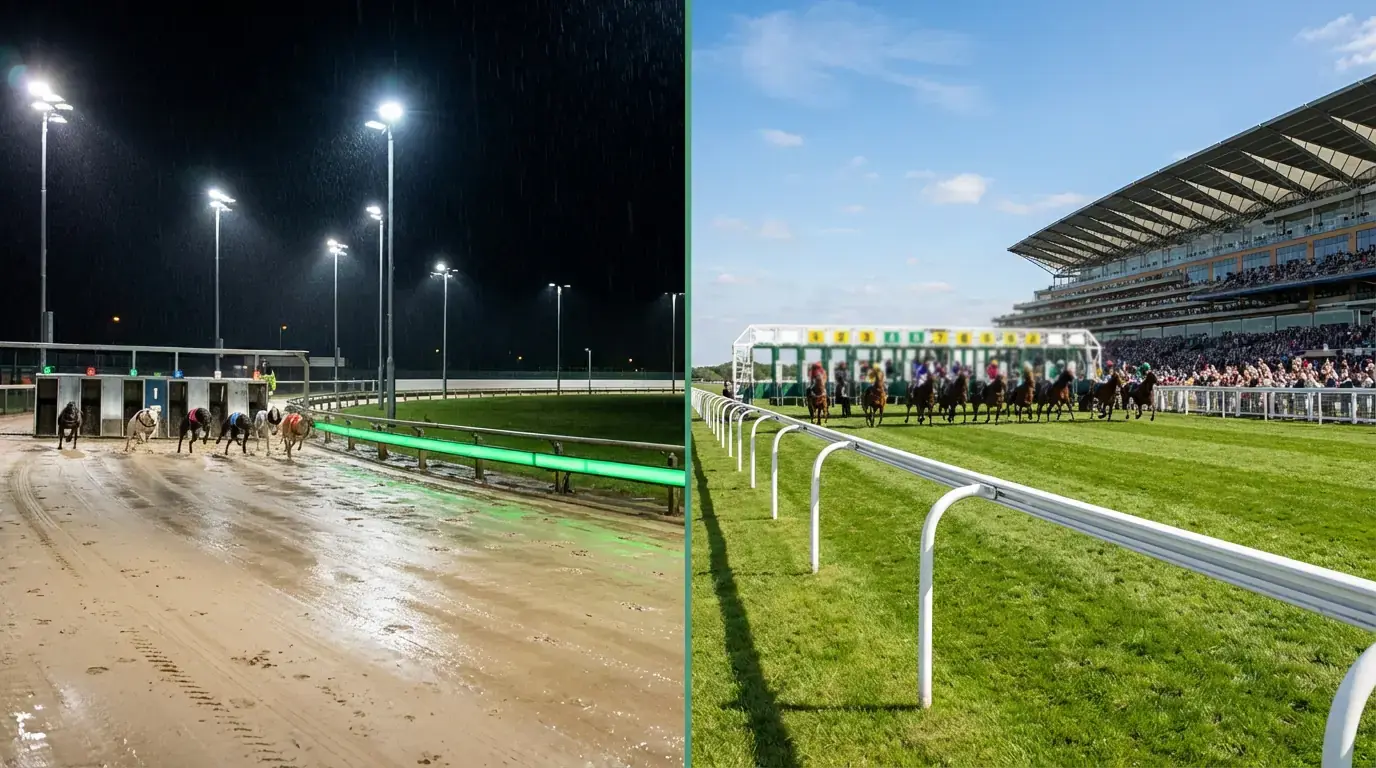
Comparing Greyhound Racing and Horse Racing Markets
Six runners versus fields of twenty — the maths alone changes everything about bet selection. The most fundamental difference between greyhound and horse racing betting is the number of competitors in each event, and its consequences ripple through every aspect of how you analyse, select, and stake your bets.
A standard UK greyhound race has six runners. A typical horse race has between eight and twenty, with some handicaps exceeding that. In a six-runner race, the favourite has an implied probability that often exceeds 30%. In a sixteen-runner handicap, the favourite’s implied probability might be 15% or less. This means greyhound favourites win more often in absolute terms, which changes the risk profile of every bet. Backing favourites on the dogs produces more frequent winners but at shorter prices. Backing favourites on the horses produces fewer winners but at prices that compensate more generously when they do land. Neither approach is inherently superior — they suit different temperaments and different staking strategies.
Frequency is the second structural divergence. UK horse racing runs daily during the flat and jumps seasons, with a handful of meetings per day and typically six to eight races per meeting. UK greyhound racing runs every day of the year, with BAGS meetings producing eighty or more races across multiple tracks in a single day. The sheer volume of greyhound racing means that a punter specialising in the dogs has far more opportunities to bet — and far more opportunities to overbet. Horse racing’s lower frequency enforces a natural discipline: there are only so many races to analyse, so the temptation to bet impulsively on something you have not studied is lower.
Market structure differs too. Horse racing attracts a broader and deeper pool of bettors, including professional punters, syndicates, and sophisticated exchange traders. This makes horse racing markets more informationally efficient — mispricings are corrected faster because more people are looking for them. Greyhound markets, by contrast, attract less total money and fewer professional participants. The markets are thinner, the odds less scrutinised, and mispricings persist longer. For a punter with genuine form knowledge, this thinness is an opportunity. The same mispricing that would be arbitraged away within minutes in a horse racing market might survive until the off in a BAGS greyhound race.
Bet types overlap substantially between the two sports — win, place, each-way, forecast, tricast — but the terms differ. Greyhound each-way bets pay two places in a six-runner field at a quarter the odds. Horse racing each-way terms vary by field size and race type, with larger fields paying three or four places and fractions ranging from a quarter to a fifth. Forecast and tricast dividends in greyhound racing are typically smaller in absolute terms but have a higher strike rate because of the smaller field sizes. A greyhound forecast requires you to find the first two from six. A horse racing forecast might require the first two from fourteen — a substantially harder proposition.
Odds Dynamics: Margins, BOG, and Market Depth
The pricing environment in each sport is shaped by the depth of its market, and that depth determines what punters pay for the privilege of betting. The specifics are worth knowing.
The bookmaker overround on greyhound racing is typically higher than on horse racing. A six-runner BAGS race might carry an overround of 118-130%, depending on the operator and the meeting. A comparable horse race at a Saturday afternoon fixture might have an overround of 110-118%. The gap is driven by competitive dynamics: more bookmakers compete aggressively on horse racing prices because the market is larger and more visible, which pushes margins down. Greyhound racing, with its lower profile and smaller betting volumes, receives less pricing attention, and the wider margins persist.
Best Odds Guaranteed is available more consistently on horse racing than on greyhound racing. Most major UK bookmakers offer BOG as a standard feature on horses, covering virtually all UK and Irish meetings. On greyhounds, BOG availability is patchier — some operators offer it on selected meetings, some run it as a periodic promotion, and some do not extend it to the dogs at all. This matters because BOG eliminates the downside of taking an early price, and its inconsistent availability on greyhounds means that the early-price versus SP decision remains a live consideration for dog punters in a way that it no longer is for horse racing bettors at BOG-offering bookmakers.
Exchange market depth is another significant difference. On Betfair, a Saturday horse race at a major meeting might have six-figure sums matched before the off. A BAGS greyhound race on the same day might have a few hundred pounds in the market. The depth difference means that exchange betting — backing and laying at true market prices — is a more practical option for horse racing than for greyhounds. Greyhound punters can and do use exchanges, but the liquidity constraints mean that meaningful stakes are harder to place at the best available price, and trading positions in-play is rarely feasible outside of major events.
The information landscape differs in depth. Horse racing benefits from a vast form study ecosystem: ratings from Timeform and Racing Post, video replays of every race, sectional timing data at most courses, and a commentariat that analyses major races in forensic detail. Greyhound form resources exist but are leaner. Sectional times are recorded, race comments are published, and speed ratings are available from services like Timeform, but the depth of public analysis is shallower. For the self-reliant punter, this is actually an advantage: less public analysis means more scope for private analysis to produce an edge.
Which Suits Your Betting Style Better?
There is no objectively better product — but there might be one that fits your temperament and time. The choice between greyhound and horse racing as a primary betting medium depends on what kind of punter you are, how much time you have, and what style of analysis suits you.
If you prefer deep analysis of a small number of events, horse racing is the natural fit. The lower frequency of races allows you to study each card thoroughly, compare your assessments with the extensive public analysis available, and place considered bets on well-researched selections. The deeper markets mean that your analytical edge needs to be sharper to survive, but the pricing infrastructure — better overrounds, more consistent BOG, deeper exchange liquidity — rewards good analysis more efficiently.
If you prefer high-frequency betting with rapid feedback, greyhound racing suits the approach. The BAGS schedule offers continuous action, the shorter race cycle means you see results quickly, and the thinner markets provide more pricing inefficiency for a skilled form reader to exploit. The trade-off is that the higher overrounds and weaker exchange liquidity create a steeper baseline to overcome, and the volume of available racing creates a discipline challenge that horse racing’s more limited schedule does not.
Some punters work both sports. Horse racing on Saturdays and feature days, greyhound racing on weekdays when the BAGS card provides the only live betting action. This hybrid approach has practical logic: it keeps the analytical skills engaged across different formats without overcommitting to the high-volume greyhound schedule. The form knowledge required is different — you cannot simply transfer horse racing analysis methods to greyhounds — but the underlying principles of value identification, odds comparison, and disciplined staking apply identically to both.
The honest assessment is that most recreational punters gravitate toward the sport they find more enjoyable to watch and study, and profitability follows engagement rather than the other way around. A punter who is genuinely fascinated by greyhound form — who enjoys studying trap draws, reading sectional times, and learning the character of individual tracks — will invest the time needed to develop an edge. A punter who finds the dogs boring but bets on them because the BAGS schedule is convenient will not. Engagement is the prerequisite. The sport matters less than the commitment to understanding it.
