
Daily Track Schedules for BAGS Greyhound Racing
Best Greyhound Betting Sites – Bet on Greyhounds in 2026
 Available in US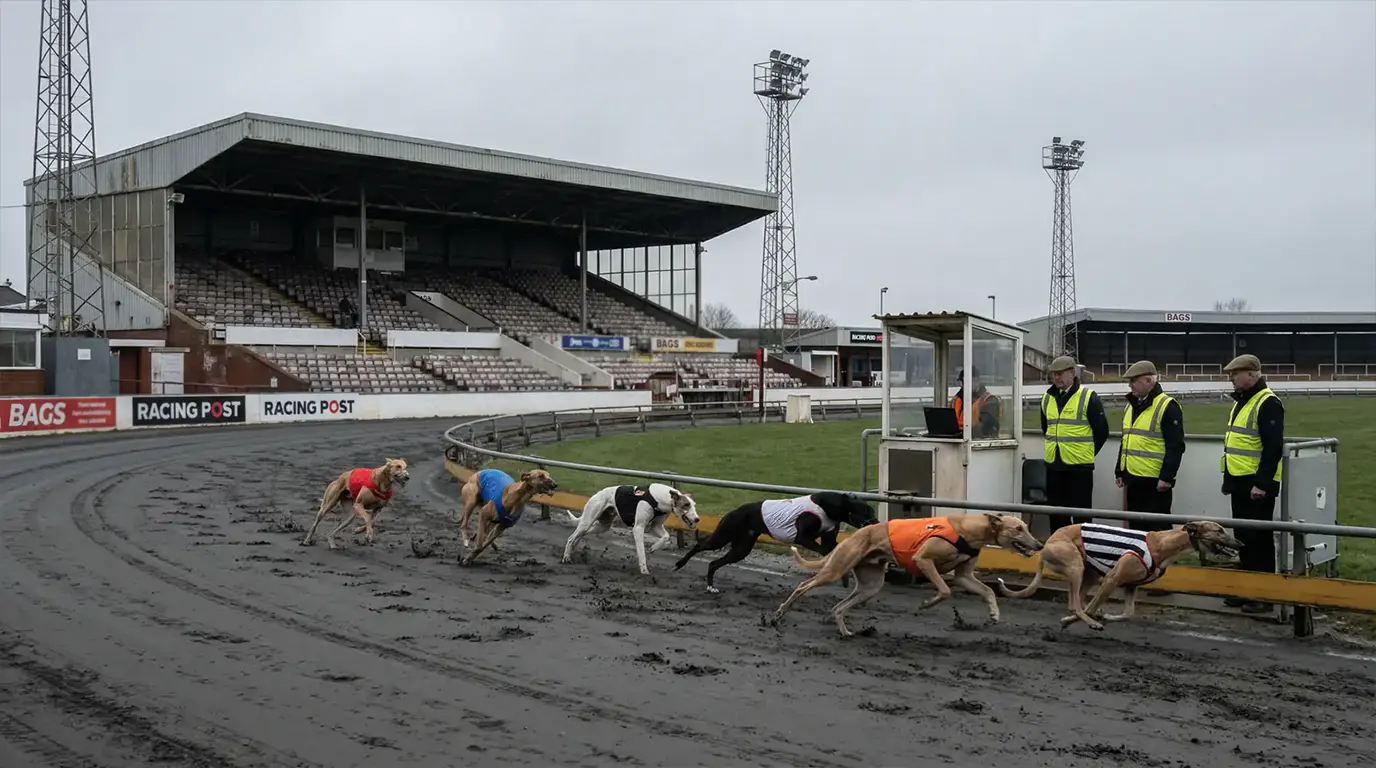
BAGS Greyhound Racing Formats and Schedule Impact
BAGS meetings are bookmaker-funded, broadcast-first, and they make up the vast majority of UK greyhound racing. If you have ever placed a greyhound bet in a betting shop or through an online bookmaker during the day, you were almost certainly betting on a BAGS race. The Bookmakers Afternoon Greyhound Service is the commercial engine that keeps most UK greyhound tracks operating, providing a continuous stream of races designed primarily for the betting market rather than for spectators in the stadium.
The BAGS model works like this. A consortium of major bookmakers collectively funds the staging of greyhound meetings at licensed tracks throughout the week. In return, the races are broadcast via SIS into betting shops and online platforms, creating a live product for punters to bet on. The bookmakers pay media rights fees and fixture payments to the tracks, and the tracks provide the facility, the dogs, and the racing officials. The revenue that keeps many UK greyhound stadiums financially viable comes not from gate receipts or prize money but from these media rights payments.
The dominance of BAGS in the UK greyhound calendar is striking. On a typical weekday, BAGS meetings run from mid-morning through to early evening, with races scheduled at regular intervals — usually every twelve to fifteen minutes — across multiple tracks simultaneously. A punter sitting in a betting shop at lunchtime might have eight or ten greyhound meetings to choose from, each producing a race roughly every quarter of an hour. That volume of content is intentional: it keeps the screens busy, the bets flowing, and the turnover high enough to justify the bookmakers’ investment in staging the races.
The tracks that host BAGS meetings span the country, from Romford and Crayford in the south to Sunderland and Kinsley in the north, with most licensed GBGB stadiums participating in the BAGS schedule to some degree. The frequency varies — some tracks host BAGS meetings several times a week, while others run them less often, supplementing with independent evening fixtures or Open race cards. For punters, this means BAGS racing is always available. There is rarely a day when a BAGS meeting is not running somewhere in the UK, and the consistency of the schedule makes it a reliable source of betting opportunities.
The standard of racing at BAGS meetings is graded. The dogs competing are assigned to grades based on their recent form at that track, and each race on the card is carded at a specific grade level. A typical BAGS meeting might feature ten to twelve races, spanning several grades from A2 or A3 down to A8 or A9, with the occasional maiden or introductory race included. The grading ensures that the races are competitive — dogs of broadly similar ability racing against each other — which is essential for producing the betting markets that BAGS is designed to serve.
BAGS vs Open Racing: Quality, Odds and Opportunity
BAGS graded races follow a structure. Open races attract the elite. And the odds reflect the difference. Understanding what separates these two types of meeting helps punters calibrate their approach, because the form dynamics, the pricing, and the betting value work differently in each context.
BAGS racing is the daily bread of UK greyhound betting. The fields are graded, the form is recent and trackable, and the racing follows a predictable rhythm. Most dogs in BAGS races are competing at their correct level — they have been assessed by the racing office and placed in a grade that reflects their current ability. This means the form book is a reasonably reliable guide. A dog’s last six runs at the same track, in the same grade, over the same distance, provide a solid basis for comparison with its rivals. The predictability of BAGS form is an advantage for punters who work methodically through the card, because the variables are relatively constrained.
The odds at BAGS meetings reflect the graded nature of the competition. Fields are typically competitive, with prices spread across a moderate range. An evenly matched BAGS race might see the favourite at 2/1 and the outsider at 8/1 — a narrow spread for a six-runner field. In less competitive BAGS races, where one dog stands out on form, the favourite might be odds-on with the rest of the field at 5/1 or longer. The bookmaker overround on BAGS markets tends to be higher than on feature races, partly because the lower profile of these meetings means less competitive pricing pressure and partly because the betting volume is distributed across dozens of races rather than concentrated on a small number of high-profile events.
Open racing is a different proposition. Open races carry no grading restriction, meaning any dog can enter regardless of its current grade. In practice, Open races attract the best dogs at a track or in the country, depending on the prestige of the event. The English Greyhound Derby, the Cesarewitch, the St Leger — these are Open races that draw the highest-rated greyhounds in training. But Open races also run at track level, featuring the fastest dogs at a particular stadium competing against each other without the cushion of grading to equalise the field.
For punters, Open races offer different value angles. The fields are typically stronger and more evenly matched in absolute terms, which means the market is tighter and the favourite wins less frequently than in a lopsided BAGS race. The form analysis is also more complex, because the dogs may have come from different grades, different tracks, and different preparation cycles. A dog stepping into an Open race for the first time after dominating in A1 graded company may or may not handle the step up. The uncertainty creates pricing inefficiency, and pricing inefficiency is where value lives.
The sharpest distinction is in market depth. Open races, particularly televised ones, attract more betting interest. The bookmaker margins tend to be thinner, the exchange markets are deeper, and the prices are more competitive. A punter who takes the time to analyse an Open race thoroughly is operating in a more efficient market — harder to find value, but the value is more reliable when found because the price is closer to the true probability. BAGS racing is less efficient but offers more frequent opportunities, with wider margins that both cost the punter more and create more scope for finding mispricings.
How BAGS Scheduling Affects Betting Markets
Morning, afternoon, and evening meetings create non-stop markets — and non-stop decisions. The BAGS schedule is designed for volume, with races running from around 10am through to early evening across multiple tracks. For the disciplined punter, this is a rich source of opportunities. For the undisciplined one, it is a conveyor belt of temptation that makes overtrading almost inevitable.
The scheduling itself has implications for market quality. Morning BAGS meetings — the first races of the day — are typically priced overnight, giving punters several hours to assess the card before the off. These early markets can be less refined than those later in the day, because they are priced from a tissue compiled without the benefit of market feedback. Early-morning prices sometimes contain the best value of the day, particularly when a compiler has misjudged a form line or underestimated the impact of a trap draw. Punters who study the cards the evening before and place bets early in the morning are, in effect, competing against the compiler’s initial assessment rather than against a seasoned market.
As the day progresses, the markets sharpen. Afternoon BAGS meetings have had time for early-morning bettors to influence the prices, and the odds tend to be more reflective of the collective market view by the time the race goes off. The value, if it existed in the morning prices, may already have been absorbed. This does not mean afternoon BAGS races are valueless — it means the edge, when it exists, is smaller and harder to find.
The volume of races is the factor that most directly affects betting discipline. On a busy BAGS day, there might be eighty or more races across all meetings between 10am and 6pm. No punter can meaningfully analyse every race in that window. The temptation to bet on races you have not studied — because the next race is about to start and the screen is right there — is the single biggest bankroll risk in BAGS betting. The structure of the schedule is optimised for turnover, and turnover is the bookmaker’s friend, not the punter’s.
The disciplined response is selectivity. Decide in advance which meetings and which races merit your attention. Focus on tracks you know, grades you understand, and distances where your form analysis is strongest. Skip everything else, no matter how inviting the next race on screen appears. The BAGS schedule will always offer another race in fifteen minutes. The punters who profit from it are the ones who let most of those races pass without a bet.
