
Watch Track Races via Live Greyhound Streaming
Best Greyhound Betting Sites – Bet on Greyhounds in 2026
 Available in US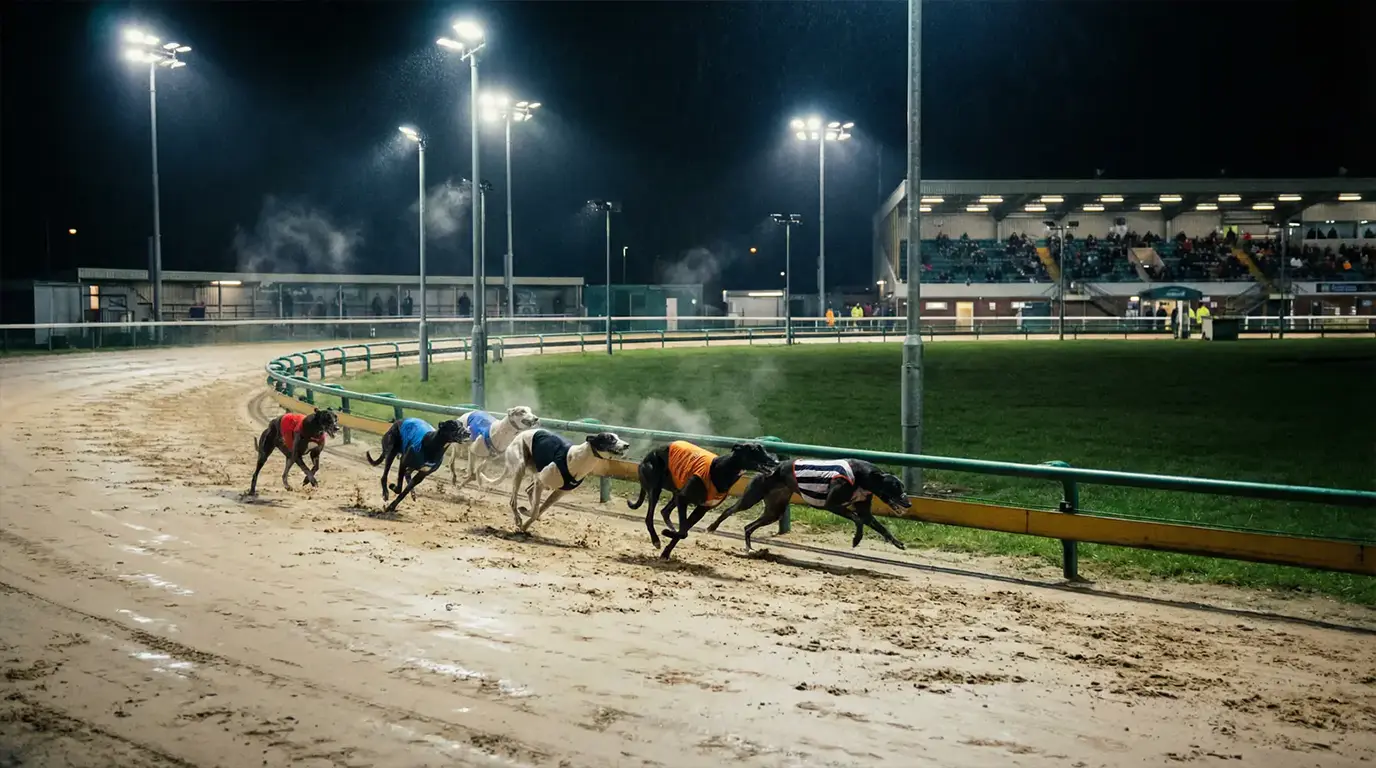
Live Streaming and In-Play Viewing for UK Greyhound Races
Most UK bookmakers stream greyhound races live, and all you typically need is a funded account. The barrier to entry is low — a registered betting account with a small balance — and the coverage is extensive. Virtually every BAGS meeting and most evening Open meetings at licensed GBGB tracks are available to watch in real time through at least one major online bookmaker. For punters who cannot attend a stadium in person, streaming is the primary way to follow the sport and, critically, to assess how dogs run rather than relying solely on the numbers on a racecard.
The standard arrangement is straightforward. You log in to your bookmaker account, navigate to the greyhound racing section, and select the race you want to watch. Most operators require either a funded account or a bet to have been placed on the meeting to unlock the stream. The funded-account threshold is usually minimal — a penny balance will do at some operators, while others require a nominal deposit or a bet of any size. The specifics vary by bookmaker and can change without notice, so checking the streaming terms before relying on a particular platform is sensible.
The quality of streams varies between providers. Some bookmakers offer full-screen, high-definition video with commentary, while others provide a smaller embedded player with ambient track sound only. The delay is another variable — live streams typically run between two and ten seconds behind the actual event, depending on the platform and your internet connection. This delay is standard across the industry and is imposed deliberately to prevent exploitation of real-time information by those with faster feeds. For betting purposes, the delay is irrelevant if you are placing pre-race bets, but it matters for in-play markets where a few seconds can change the odds.
Mobile streaming has made live greyhound coverage accessible from anywhere. Every major UK bookmaker app includes live streaming as a core feature, and the mobile experience has improved significantly in recent years. A stable 4G or 5G connection is sufficient for reliable streaming on most platforms. Wi-Fi at home is naturally more consistent, but mobile coverage means you can follow a meeting during a commute, a lunch break, or anywhere else you have your phone.
One point that newcomers sometimes miss: the coverage typically includes not just the race itself but the pre-race parade and trap loading. These visual elements provide information about condition and readiness that no racecard can convey — a dimension of form assessment explored in detail below.
Sky Sports Racing, SIS, and the Broadcast Landscape
Two broadcast providers carry virtually all UK greyhound racing, and the coverage splits along predictable lines. SIS — Sports Information Services — has historically been the backbone of greyhound broadcasting in the UK, supplying live pictures and data to betting shops and online operators. Sky Sports Racing provides a television channel dedicated to racing, covering selected greyhound meetings alongside its horse racing schedule. Between them, these two services ensure that every licensed meeting is broadcast to some audience, though the platform you watch on depends on your subscription or bookmaker.
SIS operates the signal that most bookmaker streaming services rely on. When you watch a live greyhound race through your betting account, the pictures are almost certainly coming from SIS. The company holds broadcast rights for the majority of BAGS meetings and supplies the video feed directly to licensed operators. SIS coverage is functional rather than glamorous — fixed cameras at trackside, a running clock, basic race information overlaid on screen — but it serves its purpose: showing you the race as it happens, with enough visual clarity to assess running lines and finishing positions.
Sky Sports Racing offers a more polished production. Selected greyhound meetings — typically the higher-profile evening fixtures and major events — are broadcast with full commentary, expert analysis, pre-race discussion, and multiple camera angles. The channel is available through Sky TV subscriptions, some streaming services, and certain bookmakers who include it as part of their live offering. The depth of coverage on Sky Sports Racing is genuinely useful for punters: the commentary team often highlights form angles, trap bias, and kennel information that you might not pick up from a silent SIS stream.
The distinction matters practically because not all meetings receive the same level of broadcast attention. A BAGS meeting at a smaller regional track on a Tuesday morning will be covered by SIS with minimal production. The English Greyhound Derby final will be covered by Sky Sports Racing with full studio treatment. For punters who watch to inform their betting rather than purely for entertainment, the SIS feed is sufficient. For those who want context, discussion, and occasionally a piece of insight they had not considered, Sky Sports Racing adds value when it is available.
There is also the question of data overlays. Some bookmaker streams include real-time odds, race statistics, and form summaries alongside the video. Others show the raw feed with no additional data. If you value having prices and form visible while you watch, it is worth testing different bookmaker platforms to find one whose streaming interface matches your preference. The race is the same regardless of where you watch it. The information presented around it varies considerably.
What Live Viewing Adds to Your Betting Process
Watching the pre-race parade and trap behaviour gives you information the racecard cannot provide. The racecard tells you what a dog has done — its times, finishing positions, comments from previous runs. The live picture tells you what the dog looks like right now, in this moment, before this race. The two sources of information are complementary, and punters who use both consistently make better-informed decisions than those who rely on numbers alone.
The pre-race parade is the most valuable visual window. Dogs are walked past the camera individually, usually wearing their coloured racing jackets, and you can assess their physical condition. A dog in peak condition moves fluidly, appears alert, and shows muscle tone consistent with regular work. A dog that is slightly heavy, lethargic in its movement, or showing visible discomfort may be carrying a minor issue that will affect its performance. None of this is encoded in the racecard. You can only see it if you watch.
Trap loading behaviour is another informational signal. Some dogs load into the traps calmly and face the hare with focus. Others become agitated, try to turn in the trap, or show reluctance. A dog that is upset in the traps is more likely to miss the break, which in greyhound racing is a significant disadvantage — the first stride out of the traps can determine position at the first bend. Habitual slow starters are usually noted in the form comments, but an out-of-character loading issue on a given night is something only the live viewer catches.
Watching races also helps you contextualise future form. When you read the racecard comments for a dog’s previous run and see “CkdRnUp” — checked on the run-up — you know the dog lost ground. But watching the actual race shows you how much ground was lost, where the interference occurred, and whether the dog recovered well or ran flat after the incident. A dog that was badly impeded at the first bend but finished strongly into third is a better prospect next time out than a dog that was mildly checked and still could not finish better than fourth. The distinction is in the race footage, not in the abbreviated comments.
The cumulative effect of regular viewing is pattern recognition that operates below the level of formal analysis. After watching hundreds of greyhound races, you begin to recognise running styles, track-specific tendencies, and the visual signatures of dogs in peak form. This is not mysticism — it is the same pattern recognition that any experienced observer develops in any field. Applied to greyhound betting, it supplements the form analysis with a judgement layer that is difficult to quantify but consistently useful.
