
A1 to Open Race Data in UK Greyhound Grading
Best Greyhound Betting Sites – Bet on Greyhounds in 2026
 Available in US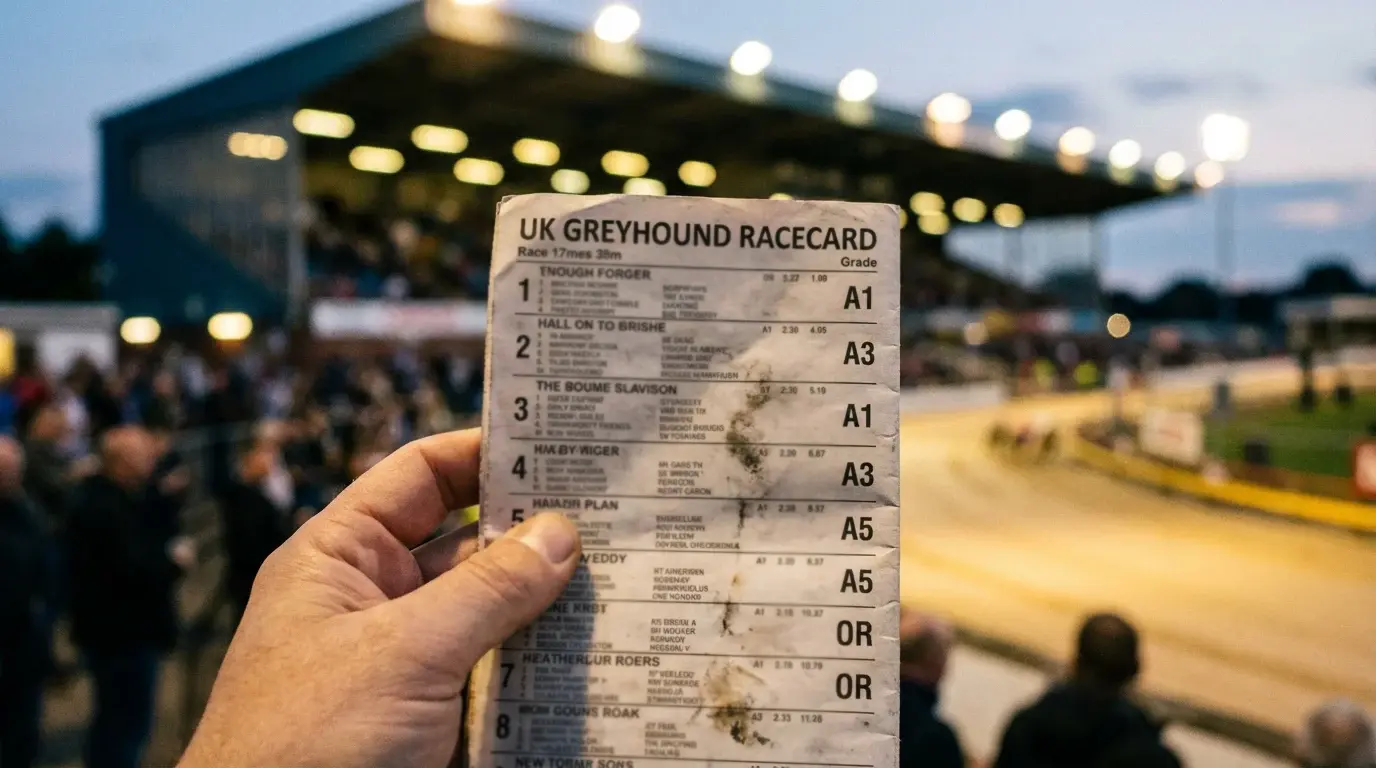
UK Greyhound Racing Grading System from A1 to Open
Grades are the class system of greyhound racing — and every grade has its own pace. Walk through the racecard for any UK meeting and you will see letters and numbers attached to each race: A1, A3, A5, A8, OR. These are not arbitrary labels. They are the grading system that determines which dogs race against which, and they exist for the same reason weight classes exist in boxing — to produce competitive contests between roughly matched opponents.
The structure is hierarchical. At the top sits Open racing, abbreviated OR, which is exactly what it sounds like: races open to any dog regardless of its normal grade, attracting the best runners at a venue. Below that, the A-grades run from A1 down to A10 or A11 depending on the track. A1 is the highest standard in graded competition; A10 is the lowest. Some tracks also run S-grades for stayers’ races and special categories for puppies and novices. The system is administered by the racing manager at each individual track, operating under the rules set by the Greyhound Board of Great Britain.
Here is the crucial detail that separates useful knowledge from trivia: grades are track-specific. An A3 dog at Romford is not the same as an A3 dog at Monmore Green. The quality of the racing population differs from venue to venue, and the grading thresholds reflect that local population rather than a national standard. A dog graded A3 at a strong track might be A2 or even A1 material at a weaker circuit. Cross-track comparisons using grade alone are unreliable, which is one reason why specialising at a small number of venues gives punters better calibration than spreading attention across the entire card.
The gap between grade levels is not uniform either. The difference in quality between A1 and A2 at a busy track is typically small — both contain genuinely fast dogs who win frequently. The difference between A7 and A8 may also be small, because at the lower end of the spectrum the dogs are closer together in ability and the grading is more about managing field composition than reflecting sharp quality distinctions. The most significant gaps tend to appear in the middle of the range, around A3 to A5, where the divide between dogs with real pace and those with limitations becomes more pronounced.
Open races sit outside this hierarchy entirely. They carry higher prize money, attract the best dogs from across the grading spectrum, and produce the most closely matched fields. For betting purposes, Open races are among the hardest to assess because the form book contains dogs from multiple grade levels whose abilities may not have been directly tested against each other. They are also where the best value sometimes hides, because the market has less certainty about relative ability and mispricing becomes more likely.
How Dogs Move Between Grades
Win and you go up; lose and you go down — but the timing of the move is where the angle lives. The basic mechanism of the grading system is promotion and relegation based on recent results. A dog that wins a race will generally be moved up a grade for its next outing, on the basis that it has demonstrated it is too good for the current level. A dog that finishes out of the places repeatedly will be dropped, on the basis that it cannot compete effectively where it is. The racing manager makes these decisions, and while the broad principle is consistent, the application involves judgement.
That judgement creates the opportunities. A racing manager might move a dog up two grades after a dominant win, or only one grade after a narrow victory in a weak field. A dog that has been placed second three times in succession without winning might stay in its current grade, because placed form is competitive even if it has not produced a win. These decisions are not arbitrary, but they are not formulaic either, and the gap between what the grading says and what the form says is where attentive punters find edges.
The timing of grade changes is particularly important. There is often a lag between a performance and the consequent grade adjustment. A dog that won impressively on Tuesday might not be regraded until the following week’s declarations. If it runs again before the regrading takes effect — which happens when tracks have quick fixture turnarounds — it competes at its old grade with improved form. Sharp punters watch for these windows, because the dog is effectively racing below its current ability level.
Grade changes also carry information about the trainer’s intentions. A trainer who campaigns a dog consistently at one track and then switches it to a different venue, where the grading thresholds are different, may be seeking easier competition. A dog graded A4 at a strong track that appears as an A5 or A6 entry at a weaker circuit is a runner whose class is above its new grade. The racecard shows the dog’s grade at the current track, but it does not automatically flag that the dog was racing at a higher level elsewhere. That cross-referencing is the punter’s job.
Regrading patterns also reveal form cycles. A dog whose grade history reads A5-A4-A3-A4-A5 over six months has hit a ceiling at A3 and settled back to its natural level. Backing that dog at A5 is reasonable; backing it next time it gets promoted to A3 requires a reason to believe something has changed. Conversely, a dog steadily climbing from A7 to A4 over several months is on an upward trajectory, and the market may not have fully adjusted to the improvement if the most recent grading still lags behind the form.
Spotting Value When a Dog Drops or Rises in Class
A grade drop isn’t always a red flag — sometimes it’s an invitation. The natural instinct when a dog is dropped from A3 to A5 is to assume it is declining. And sometimes that is exactly what is happening: the dog has lost a step, picked up a minor injury, or simply aged past its peak. But the reason for the drop matters enormously, and the punter who digs into the recent form rather than accepting the headline narrative has a significant advantage.
Consider a dog that has been running at A3 and finishing second or third consistently. It has not won, which is why the racing manager has dropped it, but it has been competitive against dogs of that standard. When it reappears at A5, it is facing slower opposition. Its recent times, its sectional splits, its running style — none of these have changed. What has changed is the quality of the dogs around it. If the form from A3 showed the dog was only narrowly beaten, the drop to A5 represents a genuine opportunity. The market may still price the dog as an A5 runner based on the grade label, when in reality it is an A3 performer in an easier field.
The opposite scenario — a dog rising in grade after a winning streak — requires more caution. A sequence of 1-1-1 looks irresistible on the racecard, but those wins may have come against weak opposition at a lower grade. The step up in class is a real test, and the market often overvalues recent wins without adequately discounting the quality of the competition. Backing a dog on the strength of a winning run without checking the grades of the races it won is one of the most common errors in greyhound betting. The form figures are impressive; the context says wait.
There is a specific pattern worth watching for: the drop from a grade where a dog was consistently placed but never won, into a grade where the standard is noticeably lower. This scenario produces some of the most reliable value in graded greyhound racing. The dog has proven ability at the higher level. It is now meeting weaker rivals. And because it has not been winning — it has only been placing — its profile does not attract the casual attention that a recent winner does. The odds are often longer than they should be, because the market rewards winners and discounts consistent placed form.
Grade rises after a single win are also worth scrutinising. A dog that won at A6 and is immediately moved to A4 — skipping a grade — faces a bigger jump in quality than one moved from A6 to A5. Double-grade promotions are the racing manager’s way of saying the win was dominant enough to warrant a bigger step up, but from a betting perspective, the jump increases the uncertainty. The dog has proven it is better than A6 standard. It has not proven it is A4 standard. Treating these situations as open questions rather than settled conclusions is a habit that pays over time.
The best use of grading analysis is longitudinal. A single grade move tells you something; a grade history over ten or fifteen races tells you much more. It reveals the dog’s ceiling, its natural level, and whether its current grade represents fair classification or a temporary misplacement. Dogs that are temporarily misgraded — either too high or too low for their actual ability — are where the grading system creates value for punters who are paying attention.
