
Track Bias Data and Greyhound Trap Draw Stats
Best Greyhound Betting Sites – Bet on Greyhounds in 2026
 Available in US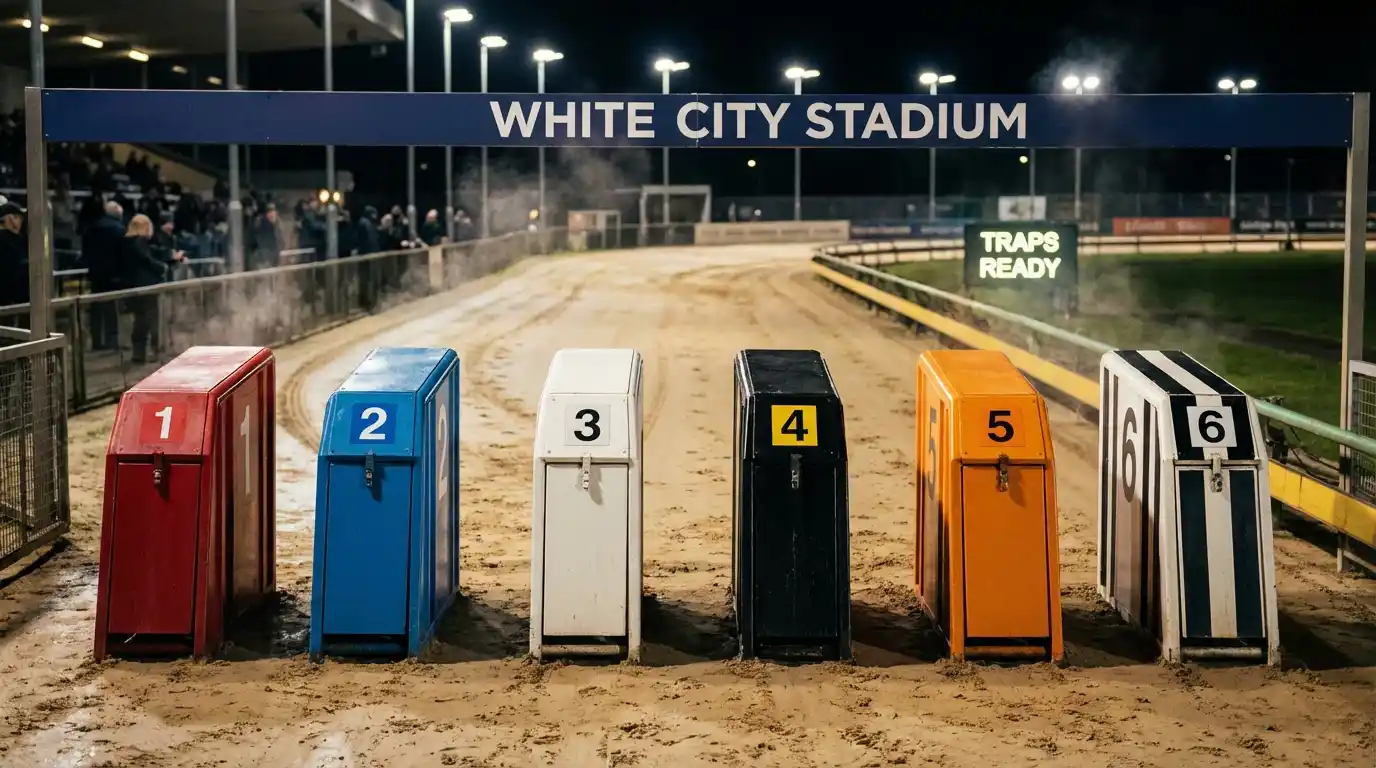
Trap Draw Statistics and Track Bias in UK Greyhounds
Trap 1 doesn’t just start on the inside — it starts with a statistical advantage at most UK tracks. That advantage is not theoretical or marginal. It is a measurable, repeatable bias that shows up across thousands of races, and it exists because of physics, not luck. The dog in Trap 1 has the shortest path to the first bend. At tracks where that bend comes quickly after the boxes open, the inside runner reaches the rail first, secures the racing line, and forces every other dog to cover extra ground. In a sport where races last thirty seconds and finishing margins are measured in hundredths, those extra metres matter.
Most casual greyhound punters look at form figures, check the recent times, maybe glance at the trainer — and ignore the trap entirely. That is a significant blind spot. The trap draw does not just influence where a dog starts; it influences the entire shape of the race. A front-runner drawn inside has a clear run to the first turn. The same dog drawn in Trap 5 or 6 needs to cross traffic to reach the rail, which introduces a risk of bumping, checking, or being forced wide. Two identical form profiles produce very different race outcomes depending on the trap assignment, and the odds do not always adjust enough to account for the difference.
The data on trap bias is publicly available and unambiguous. The Greyhound Board of Great Britain publishes results from all licensed tracks, and form services such as Timeform and the Racing Post aggregate trap statistics as part of their standard offering. Over a sample of several hundred races at any UK venue, clear patterns emerge. Some traps win significantly more often than the baseline expectation of one-in-six. Others underperform consistently. Ignoring this data is not a matter of betting style — it is leaving information on the table.
Understanding trap bias does not mean blindly backing every Trap 1 runner. It means incorporating trap draw as a genuine variable in your race assessment, weighting it alongside form, times, grade and running style. The punters who do this consistently have a structural edge over those who treat all six traps as interchangeable. It is not the only edge available in greyhound betting, but it is one of the most accessible — because the data is free and the market frequently underprices it.
Track-by-Track Trap Bias: Where the Numbers Tell the Story
Different track geometries produce different trap biases — and the variation is stark. Every licensed UK greyhound circuit has its own physical configuration: a specific circumference, a specific distance from the starting boxes to the first bend, a specific bend radius, and a specific camber on the turns. These dimensions determine how much advantage an inside draw confers and how much penalty a wide draw imposes. The bias is not uniform. At some tracks it is dramatic. At others it is barely distinguishable from noise.
Romford is the textbook example of a pronounced inside bias. The track is tight, with sharp bends and a short run from the traps to the first turn. Trap 1 at Romford wins substantially more often than the expected 16.7 percent across any meaningful sample period. The geometry is unforgiving: a dog on the rail secures the racing line early and holds it through bends that penalise any runner covering extra ground. Wide runners at Romford are fighting the physics of the circuit on every turn. The data reflects this consistently, year after year.
Crayford shows a similar, though slightly less extreme, inside bias. The circuit is compact, and the first bend comes quickly enough that the inside traps enjoy a clear positional advantage. Dogs drawn in Traps 1 and 2 at Crayford consistently outperform the market’s implied probability over large samples, which means the bookmakers’ odds do not fully account for the draw advantage — or at least do not account for it as aggressively as the data suggests they should.
Monmore Green tells a different story. The track is larger, with sweeping, generous bends that reduce the ground penalty for running wide. At Monmore, Trap 6 performs significantly better than at tighter circuits, and the overall distribution of winners across the six traps is flatter. A wide-running dog drawn in Trap 6 at Monmore faces a fundamentally different challenge from the same dog drawn in Trap 6 at Romford. The first is a manageable disadvantage; the second is a structural problem.
Towcester adds another variable entirely. The unique uphill finishing straight means that early pace, while still important at the first bend, is less decisive than at flat tracks. A dog that secures the rail early but lacks stamina for the incline can be overhauled by a stronger finisher who ran wide but had more in reserve. The trap bias at Towcester is consequently less pronounced than at most venues, and the overall winner distribution is closer to the theoretical baseline.
Sheffield, Nottingham, Hove, Sunderland, Newcastle, Perry Barr — each has its own profile. The critical point is that these profiles are not static guesses. They are derived from results data that anyone can access and analyse. A punter who checks the trap statistics for a specific track over the previous three to six months has a concrete, numerical basis for adjusting their form assessment. A punter who does not is making every selection as though the traps do not exist.
The time window matters. Trap bias data from two years ago may not reflect current conditions. Track resurfacing, adjustments to the hare system, or changes to the positioning of the starting boxes can all alter the geometry enough to shift the bias. The most reliable statistics are the most recent ones — ideally covering the last three to six months, with a sample of at least two hundred races at the relevant distance. Older data provides context but should not be treated as current.
Using Trap Data Without Overfitting Your Selections
Trap bias is real but it is one variable among many — don’t build a system on a single number. This is the point where enthusiasm for data can become a liability. A punter who discovers that Trap 1 at their local track wins 22 percent of races instead of the expected 16.7 percent might be tempted to back every Trap 1 runner and declare the problem solved. It is not solved. It is barely started.
The trap bias tells you about a population of races, not about an individual race. A 22 percent win rate for Trap 1 means that in a hundred races, that trap produces roughly twenty-two winners. It also means it produces roughly seventy-eight losers. If you backed every single Trap 1 runner at the available odds, your return would depend entirely on the prices — and since the market is at least partially aware of the bias, the odds on inside-drawn dogs at tight tracks tend to be shorter than on outside-drawn dogs, which compresses the value. You may be backing more winners, but at shorter prices, and the net effect on your return may be negligible or even negative once the overround is factored in.
The productive use of trap data is as a filter and a tiebreaker, not as a standalone system. When your form analysis narrows a six-dog race to two or three genuine contenders, the trap draw helps you separate them. A dog with strong form drawn in a statistically favourable trap has a measurable edge over a dog with equally strong form drawn in a weaker position. That is a legitimate reason to prefer one selection over the other. It is not a reason to ignore form entirely and let the trap number do all the work.
There is also the question of running style. Trap bias data aggregates all types of runners — railers, mid-track runners, wide runners — into a single number per trap. But the bias affects each type differently. A natural railer drawn in Trap 1 benefits from the inside draw far more than a wide runner drawn in the same box, because the railer’s preferred running line already matches the shortest path. A wide runner in Trap 1 will often drift out regardless of the draw, negating most of the positional advantage. Matching the dog’s running style to the trap, using the race comments from recent form, adds a layer of specificity that raw trap statistics alone cannot provide.
Sample size discipline matters as well. Trap bias calculated from fifty races is unreliable. The variance in a small sample can produce apparent biases that disappear entirely over a larger dataset. Two hundred races is a reasonable minimum for stable percentages at a given track and distance. Below that, you are measuring noise as much as signal. Some form services publish trap statistics with the sample size clearly shown; others do not. Always check. A dramatic-looking bias from a tiny sample is not a betting angle — it is an artefact.
Finally, trap data should be distance-specific. The bias at a track over the sprint distance may differ from the bias over the standard trip, because the distance from the traps to the first bend changes relative to the total race length. At some tracks, the sprint course uses a different starting position entirely, which alters the geometry. Lumping all distances together into a single trap statistic dilutes the signal. The sharpest punters filter their trap data by track and distance before drawing any conclusions.
Used correctly — as one input among several, filtered by running style and distance, verified over an adequate sample, and refreshed regularly — trap draw data is a genuine edge. Used carelessly, it is just another way to systematise a losing approach. The numbers tell a story, but only if you read them in context.
